Summary:This essay offers a paradigm-level assessment of "Emergentism Art" (涌现主义艺术), founded and named by Fan Yuzhou (范毓周), from the standpoint of art history and art theory. We do not treat "emergence" as a scientific label affixed to works of art, but rather as a resetting of the paradigm concerning "what a work of art is, who the author is, and upon what aesthetic judgment is based." To this end, we first examine the scope and limits of transplanting the Kuhn-style concept of "paradigm" into art history, pointing out that twentieth-century art history has undergone four shifts of center of gravity: "representation—medium—concept—relation." At present, contemporary art finds itself in a dispersed "post-paradigm" condition. Emergentism Art emerges from the convergence of two intellectual lineages: on the one hand, it fully absorbs and integrates British emergentist philosophy since the nineteenth century and the increasingly influential science of complex systems since the later twentieth century; on the other hand, it reconstructs—through complementarity and syncretic reframing—the Eastern generative ontology represented by the Yijing (Book of Changes), Daoism, and the painting theory of Shi Tao. From this, it proposes four propositions of Emergentism Art—ontological, epistemological, methodological, and authorial—taking the Great Image Without Form: States of Mind (大象无形:心境) and Soul of the Cosmos (宇宙之魂) series as its artistic-textual exemplars, thereby constituting a self-consistent new theoretical foundation and artistic paradigm. It explicitly advances a humanism suited to the post-human era as the soul of this paradigm shift, thereby forming an unprecedented new paradigm system. In this essay, we place it in comparative dialogue with five coordinates—traditional ink painting (shuimo), Abstract Expressionism, informel painting, systems aesthetics and generative art, and AI art—and arrive at a core judgment: the real contribution of Emergentism Art lies not in style but in converting the constitutive unit of art from "work-form" to "system-process-emergence," thereby offering a generative-ontology solution to the paradigm vacancy that follows "the end of art." Its current limitations lie in the legitimacy of scientific metaphors, the absence of evaluative criteria, and insufficient institutional verification. The essay concludes by proposing four tests for measuring a new artistic paradigm, in order to distinguish paradigm revolutions from merely discursive constructions.
Key words: Fan Yuzhou; Emergentism Art; contemporary art; artistic paradigm; complexity science; ink painting (shuimo); generative ontology
I. Introduction: Resuming the Question of Paradigm in a "Post-Historical" Condition
In December 2024, the international touring exhibition "Fractals and Chaos: Soul of the Cosmos—Emergentist Ink-Art International Touring Exhibition by Fan Yuzhou" opened in Shenzhen, together with the public reading of the "Emergentism Art Manifesto." An artistic school named after "emergence," using ink painting as its medium and complex systems as its methodology, thereby acquired a public manifesto and a name.¹ What, exactly, has "Emergentism," as a wholly new paradigm claim, changed? How much has it changed? And in what respects does it remain to be completed?
This line of questioning is necessary because contemporary art is presently in a period lacking a dominant paradigm.
Ever since Arthur C. Danto proclaimed "the end of art," the narrative of art history has no longer been governed by a single progressive thread; the history of styles has given way to the history of institutions, of media, and of global currents, and the question "What is art?" has been replaced by "What does the artworld recognize as art?"² In this context, any claim to a "new paradigm" must answer a stricter question: Is it merely a stylistic variant within an existing paradigm, or does it reset the very contract among work, author, and viewer?
II. "Paradigm" Enters Art History: Applicability and Limits of the Concept
(1) From Scientific Community to Artistic Community
In The Structure of Scientific Revolutions, Thomas S. Kuhn defined the "paradigm" as the exemplary achievement commonly accepted by a community over a given period, which simultaneously stipulates "which questions are legitimate, what counts as a solution, and what kinds of evidence are acceptable."³ A paradigm shift is thus not an accumulation of knowledge but a restructuring of the world-picture and of the way questions are posed. To transplant this concept into art history, two corrections are necessary. First, art has no "normal science" phase; plural coexistence is the norm of art. Second, the replacement of artistic paradigms is rarely accomplished by internal logic alone; it is always entangled with technology, market, politics, and media conditions. Accordingly, by "artistic paradigm" this essay means an implicit contract concerning the mode of being of the artwork, the position of the creator, the responsibility of the medium, and the basis of aesthetic judgment—not a stylistic periodization.
(2) Four Shifts of Center of Gravity
On this standard, twentieth-century art history can be summarized as four shifts of center of gravity.
The first was the dissolution of the representational contract: from Impressionism to Cubism, painting progressively relinquished its obligation to visual truth, turning instead to an examination of the mechanisms of vision itself.
The second was the establishment of the medium contract: in "Modernist Painting," Clement Greenberg defined modernism as the self-criticism in which each art takes its own medium as its object, whereby painting moved toward flatness.⁴
The third was the conceptual contract: Danto, with the notion of the "Artworld," argued that an object's becoming art depends on a theoretical atmosphere and art-historical knowledge,⁵ such that the center of gravity of the work shifted from object to concept.
The fourth was the relational and post-medium contract: Rosalind Krauss described sculpture's opening toward landscape, architecture, and performance in terms of the "expanded field";⁶ Nicolas Bourriaud understood the work as a program of social connection through "relational aesthetics."⁷ Each shift effectively re-designated the "location" of the artwork: the canvas, the medium, the concept, the network.
3) The Contemporary "Post-Paradigm" Condition
After these four shifts, the artworld has entered a dispersed "post-paradigm" condition: no single medium or method can claim to represent the spirit of the age, and global contemporary art is characterized by polycentrism, cross-mediality, and research-based practice.⁸ This explains both why claims to a "new paradigm" are so frequent in the present and why most of them are quickly absorbed by the market and the biennial system as mere styles.
Judging the authenticity of a new paradigm claim therefore requires external criteria. Four tests should be applied:
First, does it identify a class of artistic objects or events that had not previously been named?
Second, does it provide new, operable criteria of judgment?
Third, does it generate a method that can be taught, repeated, and criticized?
Fourth, does it form a community rather than a single author?
The assessment of Emergentism Art below will always proceed in relation to these four tests.
III. The Intellectual Genealogy of Emergentism
(1) British Emergentism: Irreducible Novelty
"Emergence" is not a new word. In the nineteenth century, J. S. Mill, in A System of Logic, distinguished "homopathic effects" from "heteropathic effects," and George Henry Lewes further advanced the famous distinction between the "resultant" and the "emergent": the former is the sum of its parts, while the latter is a new quality peculiar to the whole and not predictable from the parts.⁹ In the 1920s, Samuel Alexander, C. Lloyd Morgan, and C. D. Broad developed this into an ontology of stratified evolution: the universe is organized in levels, each level emerging with new qualities absent from the level below, and these new qualities are irreducible.¹⁰ This tradition provided Emergentism Art with its first important philosophical fulcrum: artistic value can reside in "novelty at the level of the whole," rather than in the exquisite arrangement of elements.
(2) The Science of Complex Systems: From Rules to Generation
The second fulcrum is the science of complex systems that took shape in the later twentieth century. Benoît Mandelbrot, with fractal geometry, described the self-similarity of nature at different scales.¹¹ Ilya Prigogine, with dissipative structures, showed how systems far from equilibrium spontaneously form order within flows of energy;¹² and John Holland, with "constrained generating procedures," explained how simple rules generate unpredictable macroscopic order.¹³ Together these theories offered a causal picture fundamentally different from classical aesthetics: order is not designed but generated in the interaction of conditions, rules, and perturbations. This directly undermines the traditional painterly premise of "having the image in mind before the brush is set down" (意在笔先).
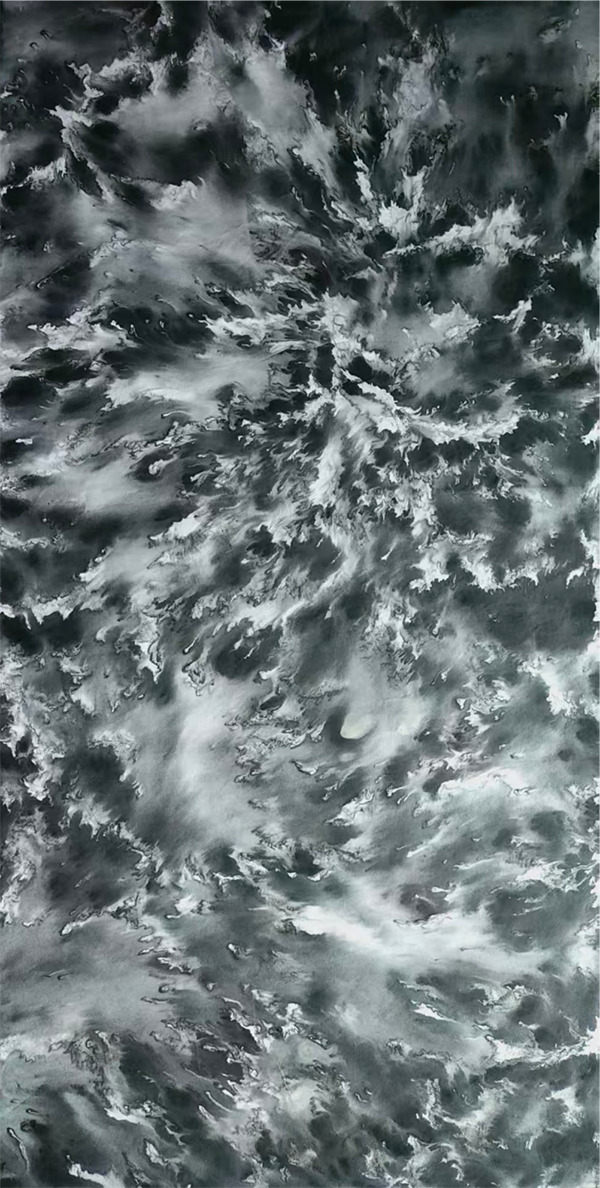
Emergentism art work :The Soul of the Universe
(3) Eastern Generative Ontology: "Life-Producing Life," "the Great Image Without Form," and "the One Stroke"
The third lineage comes from traditional Chinese philosophical thought. Drawing on the Yijing's confrontation, play, transformation, and balance of yin and yang; the Daodejing's "the great image has no form"; Buddhism's "the form arises from the mind"; and the Confucian "forgetting form to grasp meaning," I directly correspond the black-and-white relations of ink painting to the contest and fusion of yin and yang¹⁴—and this is no mere rhetorical ornament. I hold that the Xici (Appended Remarks) of the Yijing, in saying "the ceaseless production of life is what is meant by change," is itself a generative cosmology,¹⁵ and that Shi Tao, in his Quotations on Painting (Huayulu), declaring "the One Stroke is the root of all beings, the origin of the myriad forms," places the very foundation of painting in the source of generation rather than in the surface of things.¹⁶ The spiritual system of Chinese painting established from Xie He's "lively spirit and resonant vitality" (qiyun shengdong) to Zong Bing's "purifying the mind to savor images" constitutes an aesthetic tradition whose object is the circulation of vital energy (qi) and of living wholeness.¹⁷ In other words, within Chinese painting theory there has long existed a theoretical system that "privileges generation, relation, and the vital totality of the whole," yet it has never met the vocabulary of nonlinear science.
(4) The Point of Convergence: Generation Prior to Substance
The true point of convergence of the three lineages is not a collage of "science plus ink painting" but a shared ontological orientation: relation prior to element, generation prior to substance. British emergentism explains "how new qualities arise from hierarchically organized levels"; the science of complex systems explains "how order arises from nonlinear interaction"; Eastern generative ontology explains "how the myriad forms arise from the transformation of a single vital energy." The point where the three meet is precisely the theoretical foundation of Emergentism Art. This also explains why it necessarily chose ink painting as the medium embodying its painterly spirit: the relational, permeable, and not-wholly-predictable character of water, ink, and xuan paper is the material model that best expresses the spirit of this paradigm.
IV. The Paradigmatic Architecture: Four Propositions of Emergentism Art
(1) The Ontological Proposition: From "What Is Depicted" to "What Is Allowed to Happen"
Traditional painting's ontological question asks "what is depicted"—that is, the referential relationship between work and world. Emergentism Art rewrites the question as "what is allowed to happen": the work is not a specific astronomical image of the cosmos but a local embodiment of the cosmos's manner of generation. My aim is "to let art, within the natural flow [of materials], spontaneously bring forth the essence and mystery of the universe."¹⁸ This formulation converts the mode of being of art from a "noun" to a "verb," from an object to an event. Although it relinquishes the legitimacy of inherited subject matters—portrait, landscape, situation—it gains a content capable of accommodating indeterminacy, temporality, and contingency.
(2) The Epistemological Proposition: Non-Reductive Perception
Emergentism Art asks the viewer to perceive not form but the becoming of form. I emphasize the work's character of being "novel, coherent, and irreducible to its constituent parts,"¹⁹ which in effect translates British emergentism's "irreducibility" into aesthetic experience: the viewer cannot reconstruct the whole by analyzing brushstrokes, ink dots, and water marks, but must grasp, at the level of the whole, a holistic atmosphere that emerges. This mode of perception lies between rational analysis and intuitive experience, approaching the Kantian aesthetic judgment that requires universality without depending on concepts,²⁰ but with an additional layer of scientific support: the viewer is informed that the order before them is indeed generated by nonlinear rules, not by pure chance.
(3) The Methodological Proposition: Free Emergence
In method, Emergentism Art proposes the idea of "free emergence": the artist sets initial conditions—the concentration of the ink, the proportion of water, the absorbency of the paper, the position and speed of the brush's fall—and then partially cedes control to the material and participating factors, allowing the material system to diffuse, dissolve, and superimpose of its own accord under their joint action until macroscopic order emerges.²¹ This stands in opposition to the traditional Chinese painterly principle of "having the finished bamboo in the breast" (xiong you cheng zhu), and is likewise wholly different from the "body event" of Jackson Pollock's Action Painting in Western Abstract Expressionism: the latter records the energy of the subject, the former records the behavior of the system. The key to the method lies not in "randomness" but in "constrained nonlinear self-evolving randomness"—that is, a natural randomness in which contingency is constrained by initial conditions and the physicality of the materials through a nonlinear self-evolution with intrinsic participating factors, just as the fractal, amid infinite complexity, still obeys simple iterative rules.
(4) The Authorial Proposition: From Heroic Author to System Catalyst
Thus the position of the author is restructured. The artist is no longer the omniscient maker of images but the setter of conditions, the observer of the process, and the intervener at decisive moments. I especially emphasize that the artist should, with the materials, "coordinate with one another and jointly complete an irreducible emergent process."²² This new "theory of authorship" is distinctly contemporary: it echoes the "human-machine collaboration" of generative art and the post-humanist critique of "human exceptionalism." But it must be noted that ceding control does not mean abolishing the author. The choice of initial conditions, the judgment of the process, and the decision to terminate remain highly subjective acts of the artist. Emergentism is therefore not "the death of the author" but the migration of the author's function: from the master who "manufactures images" to the participant who takes the leading initiating role in "designing the conditions of generation."
V. Close Reading of the Works: From States of Mind to Soul of the Cosmos
(1) The Great Image Without Form: States of Mind: An Emotional Abstraction as Prehistory
The Great Image Without Form: States of Mind series, exhibited in 2020 at the Sanpin Art Museum in Beijing, is the prehistory for understanding Soul of the Cosmos. The works take the psychological experience of the pandemic era as their object, using vast black-and-white abstract imagery to express the philosophical recognition of "the great image without form."²³ At this stage the ink remains expressive: the density of the ink serves the tension and relaxation of emotion, and although the pictures contain an element of chance, the whole remains governed by compositional intention. This series is closer to the "new abstract expressionism" path of modern Chinese ink art than to the later systems-theoretical path.
(2) Soul of the Cosmos: Material as System
The 2024 Soul of the Cosmos series, by contrast, completes the methodological turn. Here I chose ink not for its flavor or for the expressive rendering of psychological feeling, but rather to "simulate the flow and convergence of cosmic energy" through the uncontrolled fluidity and permeability of ink; I applied extremely free brushstrokes, "arbitrarily dotting and leaving blanks without artificial presupposition," letting the ink particles act upon one another like the basic units of a system, until finally "a kind of explosive image emerges."²⁴ Visually, the pictures display three salient features. First, self-similarity: upon enlargement, one still discovers textures isomorphic with the whole—the direct visual counterpart of fractal geometry. Second, a grayscale continuum: the transitions between black and white are not flat intermediate tones but a continuous spectrum formed by countless particle-zones superimposing upon one another, corresponding to the gradual waxing and waning of yin and yang. Third, the openness of boundaries: forms have no closed contours; the brush marks naturally terminate within the fibers of the paper, so that the viewer cannot divide the picture into stable objects.
(3) Temporality: The Time of Generation
The time of traditional painting is the "time of composition": the viewer moves the gaze within an arranged spatial order. The time of an Emergentist work is the "time of generation": the picture records an irreversible process; the diffusion of the ink follows capillary action and evaporation rate, and each second's state depends on the previous second. What the viewer sees is not a finished state but the congelation of a process. This gives the works a distinctive medium-specificity in the age of photography and film: they cannot be fully pre-run by algorithm, because the microstructure of the paper fibers itself constitutes an unreproducible set of initial conditions.
(4) The Residue of Calligraphic Writing
In fact, I have not wholly abandoned calligraphic writing. My brushstrokes still bear traces of calligraphic training; the rhythm of starting, moving, and ending the stroke leaves recognizable gestures amid the chaos.²⁵ This constitutes the crucial difference between Emergentism Art and purely algorithmic generative art: the former retains the trace of the body, while the latter is characterized by its detachment from the body. It is precisely this distinction that allows the works, beyond the "system," to retain the warmth of "the human," and that supplies the material basis for its claims to a "new humanism."
VI. Five Comparisons in the Coordinates of Art History
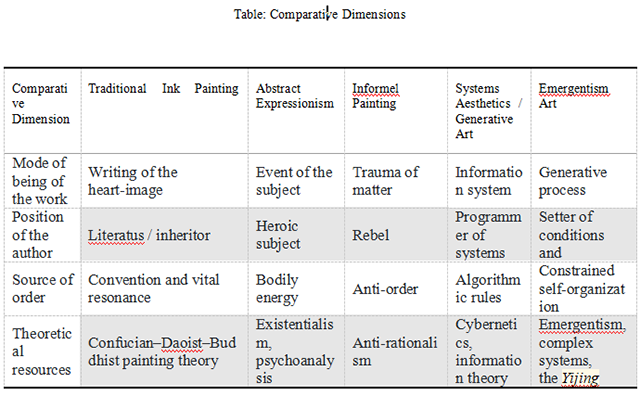
(1) With Traditional Ink Painting: Inheriting the Medium, Replacing the Philosophy
Emergentism Art inherits the complete material system of ink, xuan paper, and brush, yet replaces its philosophical core: from the cultivation of mind and heart of Confucianism, Buddhism, and Daoism, it shifts to the generative embodiment of complex systems; from the representational ethic of "learning from nature" (shi zaohua), it shifts to the ontological expression of "simulating generation"; and from the codified transmission of brush idioms (bifa), it shifts to the experimental creation of initial conditions. What it deconstructs is not ink painting as such, but its subject matters and conventions.²⁶
(2) In Distinction from Abstract Expressionism: Similar Process, Opposite Subject
Compared with the Action Painting of Jackson Pollock, both emphasize process, scale, and contingency. But the philosophical soil of Abstract Expressionism is existentialism and psychoanalysis: the work is the proof of the subject's anxiety. Emergentism Art, by contrast, is grounded in cosmic ontology, scientific realism, and systems theory: the work is the record of the behavior of a system. The former turns inward, lacking intrinsic significance and meaning; the latter turns outward, embodying the substance and spirit of cosmic change. The former centers on the artist's body; the latter centers on the nonlinearly emergent dynamics of the material.²⁷
(3) In Distinction from European Informel: Materiality versus Systems Theory
Compared with the "informel" (Art Informel) practice of Jean Fautrier, Jean Dubuffet, and others, Emergentism Art likewise values the materiality of material and its anti-geometric order. The difference is that the materiality of informel points toward trauma, flesh, and anti-reason, whereas the materiality of Emergentism Art is recoded by systems theory into a set of explainable, constrainable, and repeatable conditions of generation that embody the essence of the evolution of all things in the universe.²⁸
(4) In Distinction from Systems Aesthetics and Generative Art: Isomorphic Systems, Different Materiality
Jack Burnham proposed "systems aesthetics" in 1968, arguing that art should attend to systems and information rather than to objects;²⁹ and Philip Galanter defined generative art as the artist setting up a system with a certain autonomy and setting it in motion.³⁰ The systems of generative art are for the most part algorithmic, "dry," and reproducible. Although Emergentism Art is highly isomorphic with generative art at the level of the concept of "system," its system is physical, "wet," and un-encodable. This difference gives Emergentism Art an irreplaceable independent medium-position in the digital age.
(5) In Distinction from AI Art: Two Implementations of Emergence
AI art—especially practices based on generative adversarial networks and diffusion models—likewise works by the mechanism of "generating unpredictable images from rules and data," and likewise challenges author-centrism.³¹ But the "emergence" in the two cases belongs to different types. The emergence of AI art is computational, dependent on parameter spaces and training distributions; the emergence of Emergentism Art is material, dependent on capillary action, gravity, and the permeation of paper fibers. The former can be reproduced without limit; the latter possesses the Benjaminian uniqueness of the "here and now."³² This contrast shows precisely that Emergentism is not the rival of AI art, but its material referent.
VII. Value and Significance: Paradigmatic Contribution at Four Levels
(1) The Paradigmatic Level: A Generative Solution after "the End of Art"
After Danto, the core difficulty facing art history is: when everything can become art, how can art continue to possess distinct historical value? The answer Emergentism Art gives is not a new history of styles but a new "type of artistic object"—the artwork as an event of generation that cannot be wholly pre-performed. This exactly answers the first test proposed in this essay: it identifies a class of objects that had never before been named. Its significance lies not in replacing existing paradigms, but in offering a non-stylistic direction of advance for the "post-historical" condition.
(2) The Media Level: Redefining the Contemporary Relevance of Ink Painting
The modernization of Chinese ink painting in the twentieth century has long oscillated between the two paths of "merging China and the West" and "creating the new from tradition." Emergentism Art offers a third path: no longer taking Western abstract style as its standard, nor the literati-painting convention as its destination, it instead understands ink painting as a nonlinear material system, grounding its contemporaneity in "the behavior of the medium" rather than in a merely "cultural identity." This has important paradigmatic implications for the discourse on the autonomy of Chinese contemporary art.³³
(3) The Cultural Level: An Asymmetric Dialogue of Transcultural Modernity
Emergentism Art's juxtaposition, complementation, and fusion with complexity science can easily be taken as yet another collage of "Eastern wisdom plus Western science." But if one examines its method closely, one finds that the point of union is not a similarity of conclusions but a convergence on the common problem of "generation." The Yijing's "yin-yang generative ontology" explains how difference produces order; the dissipative structures of complexity science explain how energy produces order. This is a dialogue at the same level of the problem, not a mixing at the level of symbols. Its value lies in unifying the two in an asymmetric transcultural modernity: not taking one side as the universal standard, but taking the common problem as the mediation, therewith achieving a complementary reframing of the two.³⁴ This is, without doubt, an exemplary achievement of the rational confluence of East and West in human history.
(4) The Contemporary Level: An Artistic Rehearsal of "New Humanism" in the Age of AI
In recent years I have extended the theoretical exploration of Emergentism Art to the proposal of a "new humanism," maintaining that while acknowledging the autonomy of technical systems, one must preserve the leading position of the human.³⁵ This claim has long had empirical confirmation in artistic practice. Emergentism Art cedes control yet retains judgment; it acknowledges the system yet insists on human leadership—it is precisely the aesthetic expression of "the human is not at the center, yet remains present and takes the leading role." In the present moment of intensifying discussions of AGI, this posture carries cultural significance beyond the field of art.
VIII. Limits and Controversies: A Critical Assessment
(1) The Boundary of Scientific Metaphor
Applying "fractal," "chaos," and "emergence" to art first faces the question of the legitimacy of conceptual transposition. When scientific concepts are used across domains, if they retain only their rhetorical force while relinquishing their testability, they easily slide into "concept inflation." At present, Emergentism Art's use of fractal, chaos, synchronization, and emergence theories, while functioning as visual analogies and methodological constraints, has not yet produced strict mathematical models. This does not constitute a fatal defect: art has its own boundaries and need not submit to scientific verification. But if the theory is to maintain its seriousness, it should also clearly demarcate the boundary between "science as metaphor" and "science as method."³⁶ This is a topic for further deepening in theoretical discussions of Emergentism Art.
(2) The Expansion of the Style and the "School"
A paradigm requires the adherence of a community. At present Emergentism is chiefly associated with its founder, and there is a need to actively expand the breadth and intensity of its international promotion, to establish a stable group of artists, a system of teaching, and a critical community. Through the creativity of a wider body of artistic practitioners, the theory can be progressively deepened and refined, and the paradigmatic boundaries of Emergentism Art can be further clarified.³⁷
(3) The Establishment of Judgmental Criteria
"Free emergence" has resolved how the work is generated and given Emergentism Art a paradigmatic basis; what remains is to refine the criteria of the work. For example, with respect to the spontaneous emergence of order in the artistic whole, how is one to determine whether an emergence is a "good" emergence? Must the current criteria still make use of traditional aesthetic judgments, such as atmosphere (qixiang), tension, depth, and mood (yijing)? This means that Emergentism is revolutionary at the level of paradigm and method, yet at the level of axiology it carries a rooted inheritance. A genuinely new paradigm needs to formulate criteria for the failure of emergence—that is, for distinguishing those emergences that lack ontological significance and are mediocre, ineffective, or mystificatory.
(4) The Insufficiency of Institutional Verification
At present, Emergentism Art needs to further expand its international influence, gradually entering peer review in international academic journals, the collection and research sequences of major museums, and the curatorial frameworks of international biennials.³⁸ The absence of institutional verification does not negate its value. Historically, Fauvism, Futurism, and Abstract Expressionism all underwent similar lags; this limitation is therefore provisional rather than terminal.
IV. Conclusion: The Portability of the Paradigm
What, precisely, has Emergentism Art changed?
It has changed not the form of the picture, but the very mode of being of painting. Within its framework, the artwork is no longer a completed object but a recorded generative process; the author is no longer the sole maker of images but the leading setter of conditions and the catalyst of the system; the medium is no longer an instrument of expression but a collaborator with autonomous behavior; and aesthetic judgment no longer concerns form alone but the perceptibility of the process and the credibility of order. Taken together, these four points constitute a genuine resetting of the paradigm, not merely a stylistic update.
Over the long durée of art history, what is most worth cherishing in Emergentism Art is not merely the answer it gives, but the question it raises: in an age when algorithms can generate every image, must art still insist on a generation that is material, unrepeatable, and embodied-present? Its answer is in the affirmative—and it has made that answer emerge on xuan paper. This is at once a distant response to the twentieth century's theory of medium-specificity and a silent rebuttal to the technological optimism of the twenty-first.
We clearly recognize that, as a wholly new "paradigm," Emergentism Art still has much work to do. We will continue to refine it: to translate the scientific vocabulary into a testable methodology; to expand the programmatic theory and practice of the school into a teachable, widely shared communal practice; and to elevate aesthetic intuition into decidable evaluative criteria. These efforts will carry Emergentism Art into the hall of international art history.
Notes
[1] Fan Yuzhou, "Emergentist Art Manifesto," in Fractals and Chaos: The Soul of the Cosmos—Fan Yuzhou's Emergentist Ink-Wash Art International Touring Exhibition, Shenzhen premiere, Shenzhen Fan Yuzhou Art Museum, December 2024; see also "Fractals and Chaos: The Soul of the Cosmos: The (Shenzhen) Premiere of Fan Yuzhou's Emergentist Ink-Wash Art International Touring Exhibition Opens," Nanfang Daily (Nanfang+), December 19, 2024.
[2] Arthur C. Danto, "The End of Art," in The Philosophical Disenfranchisement of Art (New York: Columbia University Press, 1986), 81–115; Arthur C. Danto, After the End of Art: Contemporary Art and the Pale of History (Princeton, NJ: Princeton University Press, 1997).
[3] Thomas S. Kuhn, The Structure of Scientific Revolutions, 2nd ed. (Chicago: University of Chicago Press, 1970), 10–11, 182–87.
[4] Clement Greenberg, "Modernist Painting," in The Collected Essays and Criticism, vol. 4, Modernism with a Vengeance, 1957–1969, ed. John O'Brian (Chicago: University of Chicago Press, 1993), 85–93.
[5] Arthur C. Danto, "The Artworld," Journal of Philosophy 61, no. 19 (1964): 571–84.
[6] Rosalind Krauss, "Sculpture in the Expanded Field," October 8 (Spring 1979): 30–44.
[7] Nicolas Bourriaud, Relational Aesthetics, trans. Simon Pleasance and Fronza Woods (Dijon: Les presses du réel, 2002), 11–24.
[8] Terry Smith, Contemporary Art: World Currents (London: Laurence King, 2011), 15–38; Boris Groys, In the Flow (London: Verso, 2018), 1–20.
[9] John Stuart Mill, A System of Logic, Ratiocinative and Inductive (London: John W. Parker, 1843), bk. 3, chap. 6; George Henry Lewes, Problems of Life and Mind, vol. 2 (London: Trübner, 1875), 412–16.
[10] Samuel Alexander, Space, Time, and Deity, 2 vols. (London: Macmillan, 1920); C. Lloyd Morgan, Emergent Evolution (London: Williams and Norgate, 1923); C. D. Broad, The Mind and Its Place in Nature (London: Kegan Paul, 1925), 55–80.
[11] Benoît B. Mandelbrot, The Fractal Geometry of Nature (New York: W. H. Freeman, 1982), 1–35.
[12] Ilya Prigogine and Isabelle Stengers, Order out of Chaos: Man's New Dialogue with Nature (New York: Bantam Books, 1984), 12–43.
[13] John H. Holland, Emergence: From Chaos to Order (Reading, MA: Addison-Wesley, 1998), 1–40; P. W. Anderson, "More Is Different," Science 177, no. 4047 (1972): 393–96.
[14] Fan Yuzhou, "The Soul of the Cosmos: The Art of Emergence and the Emergence of Art," US China Times, December 17, 2024.
[15] Zhouyi Zhengyi (The Correct Meaning of the Zhouyi), with commentaries by Wang Bi and subcommentary by Kong Yingda, in Shisanjing Zhushu (Commentaries and Subcommentaries on the Thirteen Classics) (Beijing: Zhonghua Shuju, 1980), "Xici Shang" (The Great Treatise, Part I).
[16] Shi Tao, Kugua Heshang Huayulu (Quotations on Painting by the Monk Bitter Gourd [Shi Tao]), in Yu Jianhua, ed., Zhongguo Gudai Hualun Leibian (Classified Compendium of Ancient Chinese Painting Theory) (Beijing: People's Fine Arts Publishing House, 1998), "Yihua Zhang Diyi" (Chapter One: On the Single Stroke).
[17] Zong Bing, Hua Shanshui Xu (Preface on Painting Landscape); Xie He, Gu Hua Pin Lu (Classification of Ancient Painters), both in Yu Jianhua, ed., Zhongguo Gudai Hualun Leibian (Classified Compendium of Ancient Chinese Painting Theory).
[18] Fan Yuzhou, "The Soul of the Cosmos: The Art of Emergence and the Emergence of Art," US China Times, December 17, 2024.
[19] Ibid.
[20] Immanuel Kant, Critique of Judgment, trans. Werner S. Pluhar (Indianapolis: Hackett, 1987), 43–54.
[21] Fan Yuzhou, "The Soul of the Cosmos: The Art of Emergence and the Emergence of Art"; see also Wen Qing, "Opening the Gate of Artistic Iterative Innovation at the Confluence of Philosophy, Science, and Art: The Theory, Paradigm, and Future Prospects of Emergentist Art Seen from the Coordinates of Art History," US China Times, February 27, 2026.
[22] Ibid.
[23] "A Brief Introduction to Professor Fan Yuzhou," in "The Soul of the Cosmos: The Art of Emergence and the Emergence of Art," US China Times, December 17, 2024.
[24] Fan Yuzhou, "The Soul of the Cosmos: The Art of Emergence and the Emergence of Art."
[25] Sun Jianglin, "Professor Fan Yuzhou's Artistic Achievements and Path of Exploration," Jiangnan Times, May 15, 2025.
[26] Wen C. Fong, "Why Chinese Painting Is History," The Art Bulletin 85, no. 2 (2003): 258–80; Michael Sullivan, Art and Artists of Twentieth-Century China (Berkeley: University of California Press, 1996), 299–316.
[27] Michael Leja, Reframing Abstract Expressionism: Subjectivity and Painting in the 1940s (New Haven, CT: Yale University Press, 1993), 1–30.
[28] Hal Foster, "The Expressive Fallacy," in Recodings: Art, Spectacle, Cultural Politics (Seattle: Bay Press, 1985), 59–77.
[29] Jack Burnham, "Systems Aesthetics," Artforum 7, no. 1 (September 1968): 30–35.
[30] Philip Galanter, "What Is Generative Art? Complexity Theory as a Context for Art Theory," in GA2003: 6th Generative Art Conference Proceedings (Milan: Generative Art, 2003), 1–12.
[31] Lev Manovich, The Language of New Media (Cambridge, MA: MIT Press, 2001), 27–48.
[32] Walter Benjamin, "The Work of Art in the Age of Its Technological Reproducibility," in The Work of Art in the Age of Its Technological Reproducibility, and Other Writings on Media, ed. Michael W. Jennings et al. (Cambridge, MA: Harvard University Press, 2008), 19–55.
[33] Gao Minglu et al., Zhongguo Dangdai Meishu Shi 1985–1986 (A History of Contemporary Chinese Art, 1985–1986) (Shanghai: Shanghai People's Publishing House, 1991), 3–28.
[34] Li Shuhua, Cong Xitonglun dao Hundunxue: Xinxi Shidai de Kexue Jingshen yu Kexue Jiaoyu (From Systems Theory to Chaos Theory: The Scientific Spirit and Scientific Education in the Information Age) (Guilin: Guangxi Normal University Press, 2002), 117–46.
[35] On Fan Yuzhou's discussion of "new humanism," see "A New Realm of Human Art: Toward an 'Emergentist Art' for the Future," US China Times, October 19, 2026.
[36] On the legitimacy of transposing scientific concepts across domains, see Peter Galison, Image and Logic: A Material Culture of Microphysics (Chicago: University of Chicago Press, 1997), 1–20; here I adopt only its argument that "concepts carry their material and institutional conditions," without drawing any direct analogy.
[37] Wen Qing, "Opening the Gate of Artistic Iterative Innovation at the Confluence of Philosophy, Science, and Art," likewise notes that Emergentism is currently "highly concentrated in its founder," with no deep research in independent academic journals.
[38] Ibid.
Reference
Alexander, Samuel. Space, Time, and Deity. 2 vols. London: Macmillan, 1920.
Anderson, P. W. "More Is Different." Science 177, no. 4047 (1972): 393–96.
Benjamin, Walter. "The Work of Art in the Age of Its Technological Reproducibility." In The Work of Art in the Age of Its Technological Reproducibility, and Other Writings on Media, edited by Michael W. Jennings, Brigid Doherty, and Thomas Y. Levin, 19–55. Cambridge, MA: Harvard University Press, 2008.
Bourriaud, Nicolas. Relational Aesthetics. Translated by Simon Pleasance and Fronza Woods. Dijon: Les presses du réel, 2002.
Broad, C. D. The Mind and Its Place in Nature. London: Kegan Paul, 1925.
Burnham, Jack. "Systems Aesthetics." Artforum 7, no. 1 (September 1968): 30–35.
Danto, Arthur C. "The Artworld." Journal of Philosophy 61, no. 19 (1964): 571–84.
Danto, Arthur C. After the End of Art: Contemporary Art and the Pale of History. Princeton, NJ: Princeton University Press, 1997.
Danto, Arthur C. "The End of Art." In The Philosophical Disenfranchisement of Art, 81–115. New York: Columbia University Press, 1986.
Fan Yuzhou. "The Soul of the Cosmos: The Art of Emergence and the Emergence of Art." US China Times, December 17, 2024.
Fan Yuzhou. The Emergentist Art Manifesto. Shenzhen: Shenzhen Fan Yuzhou Art Museum, December 2024.
Fong, Wen C. "Why Chinese Painting Is History." The Art Bulletin 85, no. 2 (2003): 258–80.
Foster, Hal. "The Expressive Fallacy." In Recodings: Art, Spectacle, Cultural Politics, 59–77. Seattle: Bay Press, 1985.
Galanter, Philip. "What Is Generative Art? Complexity Theory as a Context for Art Theory." In GA2003: 6th Generative Art Conference Proceedings, 1–12. Milan: Generative Art, 2003.
Galison, Peter. Image and Logic: A Material Culture of Microphysics. Chicago: University of Chicago Press, 1997.
Gao Minglu et al. Zhongguo Dangdai Meishu Shi 1985–1986 (A History of Contemporary Chinese Art, 1985–1986). Shanghai: Shanghai People's Publishing House, 1991.
Greenberg, Clement. "Modernist Painting." In The Collected Essays and Criticism, vol. 4, Modernism with a Vengeance, 1957–1969, edited by John O'Brian, 85–93. Chicago: University of Chicago Press, 1993.
Groys, Boris. In the Flow. London: Verso, 2018.
Holland, John H. Emergence: From Chaos to Order. Reading, MA: Addison-Wesley, 1998.
Kant, Immanuel. Critique of Judgment. Translated by Werner S. Pluhar. Indianapolis: Hackett, 1987.
Krauss, Rosalind. "Sculpture in the Expanded Field." October 8 (Spring 1979): 30–44.
Kuhn, Thomas S. The Structure of Scientific Revolutions. 2nd ed. Chicago: University of Chicago Press, 1970.
Leja, Michael. Reframing Abstract Expressionism: Subjectivity and Painting in the 1940s. New Haven, CT: Yale University Press, 1993.
Lewes, George Henry. Problems of Life and Mind. Vol. 2. London: Trübner, 1875.
Li Shuhua. Cong Xitonglun dao Hundunxue: Xinxi Shidai de Kexue Jingshen yu Kexue Jiaoyu (From Systems Theory to Chaos Theory: The Scientific Spirit and Scientific Education in the Information Age). Guilin: Guangxi Normal University Press, 2002.
Mandelbrot, Benoît B. The Fractal Geometry of Nature. New York: W. H. Freeman, 1982.
Manovich, Lev. The Language of New Media. Cambridge, MA: MIT Press, 2001.
Mill, John Stuart. A System of Logic, Ratiocinative and Inductive. London: John W. Parker, 1843.
Morgan, C. Lloyd. Emergent Evolution. London: Williams and Norgate, 1923.
Prigogine, Ilya, and Isabelle Stengers. Order out of Chaos: Man's New Dialogue with Nature. New York: Bantam Books, 1984.
Shi Tao. Kugua Heshang Huayulu (Quotations on Painting by the Monk Bitter Gourd). In Zhongguo Gudai Hualun Leibian (Classified Compendium of Ancient Chinese Painting Theory), compiled by Yu Jianhua. Beijing: People's Fine Arts Publishing House, 1998.
Smith, Terry. Contemporary Art: World Currents. London: Laurence King, 2011.
Sullivan, Michael. Art and Artists of Twentieth-Century China. Berkeley: University of California Press, 1996.
Wang Bi, commentaries, and Kong Yingda, subcommentary. Zhouyi Zhengyi (The Correct Meaning of the Zhouyi). In Shisanjing Zhushu (Commentaries and Subcommentaries on the Thirteen Classics). Beijing: Zhonghua Shuju, 1980.
Xie He. Gu Hua Pin Lu (Classification of Ancient Painters). In Zhongguo Gudai Hualun Leibian (Classified Compendium of Ancient Chinese Painting Theory), compiled by Yu Jianhua. Beijing: People's Fine Arts Publishing House, 1998.
Yu Jianhua, ed. Zhongguo Gudai Hualun Leibian (Classified Compendium of Ancient Chinese Painting Theory). Beijing: People's Fine Arts Publishing House, 1998.
Zong Bing. Hua Shanshui Xu (Preface on Painting Landscape). In Zhongguo Gudai Hualun Leibian (Classified Compendium of Ancient Chinese Painting Theory), compiled by Yu Jianhua. Beijing: People's Fine Arts Publishing House, 1998.
相关链接:
艺术范式的根本变革:涌现主义艺术在国际艺术创新中的价值与意义
直面宇宙本质的艺术:涌现主义艺术的理论创新与范式革命
从笔墨写意到自然涌现——论范毓周水墨艺术的创新与美学价值
超越与重构:涌现主义艺术对当代艺术的美学超越与主题转换的价值及意义
人类艺术的新境界:面向未来的“涌现主义艺术”
《周易》研究的现代转型:范毓周在《周易》与当代前沿科学互补重构的贡献与影响
象数体系与AGI:《周易》对人工智能未来发展的价值与意义
后人类时代的新人本主义艺术典范:涌现主义艺术的影响与意义
宇宙演化的灵魂:涌现主义的宇宙观
Artistic Innovation in the Twilight of Contemporary Art: The Value and Significance of Emergentism Art
当代艺术暮色中的艺术创新:涌现主义艺术的价值与意义
The Unity and Integration of Metaphysics and Science: The Complementary Reconstruction Value of the I Ching and Complexity Theory and Quantum Science
形而上学对当前科学疑难问题的阐释:从《周易》哲学认知体系视角看量子实验中的“幽灵”现象
形而上学与科学的统一与整合: 《周易》与复杂性理论、量子科学互补重构的价值与意义
玄学与科学的优势互补与融合:《周易》数理体系与量子理论的相互完善与理论重构
Complementary Advantages and Integration of Metaphysics and Science: Mutual Improvement and Theoretical Reconstruction of the Mathematical System in I Ching and Quantum Theory
范毓周:玄学的科学化与科学的玄学化
范毓周教授抽象水墨画的周易美学精神
“笔墨当随时代”:简析范毓周涌现主义艺术作品
范毓周教授的艺术成就与探索之路
意大利艺术评论家评范毓周涌现主义艺术
浑然天成:范毓周对美学的经验之谈
墨韵中的宇宙灵魂交响曲:范毓周涌现主义作品《宇宙之魂》系列评析
范毓周艺术馆发布涌现主义艺术宣言
范毓周《宇宙之魂》:涌现的艺术与艺术的涌现
范毓周做客中国金融网:畅谈心境水墨艺术创新
范毓周心境水墨艺术全球巡展北京展启幕
范毓周当代心境水墨艺术全球巡展在北京启动