Introduction: At the Crossroads of ContemporaryArt
In2026, as we examine the global art landscape, a complex and contradictory panoramaunfolds before us. Contemporary Art (Contemporary Art), with its unprecedenteddiversity, interdisciplinary nature, and subversive concepts, has taken centerstage in cultural discourse. Yet beneath this seemingly prosperous scene, aprofound sense of crisis and directional confusion is quietly permeating.Growing critical voices point out that after undergoing the baptism ofpostmodernism, contemporary art is now entering a twilight of "aestheticspiritual decline." This is prominently manifested in the increasinglyblurred boundaries between art and life through the "lifification"trend, as well as the "secularization" trajectory driven byconsumerism and market logic. Art, once regarded as the pinnacle of humanspirit, seems to be losing its transcendent aura, reducing to mere footnotes ofdaily life, embellishments of social spectacles, or expensive commodities incapital markets.
The core of thiscrisis lies in the void of artistic conceptual significance. As traditionalaesthetic standards are deconstructed, grand narratives are challenged, andart's critical function is weakened by cynicism and the wave of entertainment,the very foundation of art's existence begins to waver. Many theorists, such asAdorno and Vattimo, had long predicted the "end" or"crisis" that art might face in the late modern era. Today, we findourselves in an age where these predictions are being repeatedly validated.Contemporary art seems to have entered a vast labyrinth, brimming with infinitepossibilities yet lacking a clear exit to the future. In a sense, thissignifies that contemporary art has entered a twilight-like state, leavingbehind a series of confusion and melancholy.
Yet the twilight ofany era harbors the dawn of new life. Against the backdrop of contemporary artconfronting profound ontological crises, a groundbreaking artistic paradigm— "Emergentism Art" —has emerged. This movementtranscends mere rebellion or stylistic iteration; it represents a fundamentalparadigm shift rooted in the fusion of Eastern philosophical perspectives with21st-century scientific frontiers. Drawing profound insights from themacrophilosophical frameworks of the Zhouyi (Book of Changes) and Confucianism,Buddhism, and Taoism, while gaining scientific inspiration from fractal geometry,chaos theory, synchronization, and emergent systems in complexity science,Emergentism seeks to reconnect art with the cosmic essence, life's meaning, andthe mysteries of consciousness. It redefines the spiritual dimension of art andproposes a generative approach that surpasses the "concept-first"paradigm. In an era where algorithmic art increasingly replaces human creation,this movement advocates a neo-humanist creative model that integrates humancreativity with natural processes, thereby reestablishing art's aestheticspirit and humanistic values.
This studyinvestigates the underlying mechanisms and causes of the aesthetic decline incontemporary art, along with its increasing secularization and lifestyleorientation. Using this framework, it systematically examines the philosophicalcore, aesthetic principles, and creative paradigms of emergentism art.Comparative analysis reveals that emergentism art not only offers a freshperspective for reevaluating contemporary art's challenges, but moreimportantly, its distinctive worldview, constructive approach, and emphasis onprocess and generation demonstrate an inevitable trajectory of artisticinnovation. This trend suggests that future artistic innovation will transcendthe spiritual void left by post-deconstructivist trends, reestablishing thelong-lost profound connection between art and truth, life, consciousness, andthe cosmos. Such innovation will ultimately manifest its irreplaceablecontemporary value and enduring significance.
I TheTwilight of Contemporary Art:
The Decline of Aesthetic Spirit and the Dilemma of Secularization.
The 'twilight' ofcontemporary art does not signify the end of its vitality, but rather theblurring and dimming of the core value system that once guided its progress.This 'twilight' is primarily manifested in the systematic dissolution ofaesthetic spirit, the limitless permeation of art into life, and the resultingwidespread absence of spiritual dimension.
1.1 TheDissolution of Aesthetic Spirit and the Discourse on "The End of Art"
One of the coredriving forces of modernist art lies in the pursuit of autonomy in"beauty" and the continuous exploration of artistic forms. However,since the mid-20th century, particularly after Marcel Duchamp's conceptualrevolution, the focus of art has undergone a fundamental shift. Duchamp's"Fountain" not only challenged the definition of artworks but, moreimportantly, abstracted art's value from material forms and aestheticexperiences, transplanting it into the conceptual frameworks of artists andinstitutional contexts. This turn reached its peak in the postmodernist era,giving rise to a widespread tendency of "anti-aesthetics" or"de-aesthetization."
This perspectivecontends that traditional "beauty" functions as an oppressiveideological instrument defined by specific social classes and culturalframeworks, thus requiring deconstruction and subversion. Art has shifted itsprimary mission from aesthetic pleasure or spiritual elevation to socialcritique, political engagement, philosophical inquiry, and cultural identityexploration. While this transformation has significantly expanded art'sboundaries and functions, it has also come at a heavy cost. Art has graduallybecome detached from its sensory foundations and spiritual essence. When awork's value is entirely determined by its conceptual interpretation orcritical stance, art risks degenerating into mere schematic diagrams of ideasor sociological reports.
Against this backdrop,the discourse of "The End of Art" has gained significant traction.Arthur Danto's concept of "the end of art" does not imply a cessationof artistic creation, but rather the conclusion of art's inherent historicalprogression. He argues that since Andy Warhol's "Brillo Boxes,"anything can be deemed art, with the boundary between art and philosophy havingdissolved. The art history narrative, once a clear and progressive direction,has now come to an end. This perspective profoundly reveals that contemporaryart exists in a "post-historical" and normative chaos, a "Artworld" devoid of mainstream styles or unified aesthetic standards, reducedto endless personal expressions and stylistic parodies.
The erosion of thisaesthetic ethos has directly precipitated the disarray and nihilism in artevaluation standards. When "beauty" is banished, the sublime ismocked as anachronistic sentimentality, and profundity is reduced to linguisticplay, art's intrinsic value loses its foundation. Many contemporary artworksleave audiences with an immediate sense of "incomprehensibility" —abarrier not rooted in depth but in their highly insular meanings and excessiveemphasis on theoretical knowledge. The bridge once built between art and thepublic through aesthetic experience has crumbled, replaced by a towering wallconstructed by the discursive power of curators, critics, and theorists.Ultimately, the value of art is reduced to market prices, exhibition histories,and academic recognition, forming a self-perpetuating, self-justifying closedcommercial system.
1.2 The Lack of Spiritual Dimension:The Internal Crisis of Contemporary Art
Inconclusion, the dissolution of aesthetic spirit and the dual trends oflife-oriented and secularization have jointly led to the most profoundintrinsic crisis in contemporary art: the absence of spiritual dimension. Here,"spirit" does not specifically refer to any religious belief, butrather to the ability of art to transcend the material world, touch upon thefundamental issues of human existence, and evoke profound emotional resonanceand intellectual enlightenment.
When art abandons itspursuit of "beauty" and "sublimity," it forfeits a vitalsensory pathway to the spiritual realm. When art becomes indistinguishable fromlife, it relinquishes its unique status as the "other" of existence, aposition that enables it to reflect upon, critique, and elevate life. Whenart's value is reduced to conceptual interpretation and market logic, itdegenerates into an intellectual or capital game, drifting further from ordinarypeople's need for spiritual elevation. Many critics rightly describe this stateas "Empty Aesthetics" or "the loss of the soul." Whileartworks may be conceptually intricate and formally diverse, they often remainemotionally cold and spiritually barren.
This situation unmistakablyreveals the twilight of contemporary art. Having abandoned notions of 'beauty'and 'sublimity,' contemporary art has become a vast realm—technologically advanced yetideologically free, yet spiritually lost, hollow, and vulgar. It resembles acompassless explorer wandering aimlessly across boundless frontiers. At thispivotal historical juncture, the call for a new paradigm that could reestablishartistic foundations and spiritual dimensions has never been more urgent. The emergenceof emergent art stands as a profound response to this era's imperative.
II. Dawn Light:
ThePhilosophical Cornerstone and New Aesthetic Paradigm of Emergent Art
Amid the twilight of contemporaryart, emergent art emerges like a dawn light, presenting a radically differentworldview and artistic approach. It is not merely a stylistic innovation but aprofound philosophical revolution in art, rooted in Eastern philosophicalunderstanding and the cutting-edge scientific thinking of the 21st century. Itsaim is to reestablish the ontological connections between art and the universe,life, and consciousness.
2.1 Philosophical Origins of "Emergence": From Complexity Science toArtistic Concepts
To comprehend emergentism art, wemust first grasp its core concept— "Emergence." The term was firstcoined by British philosopher George Henry Lewes in 1875, tracing itsintellectual roots to John Stuart Mill's distinction between causality. Itsorigins extend back to Aristotle's ancient Greek philosophy, where he assertedthat "the whole is greater than the sum of its parts." In the early20th century, the "British Emergentists" school, represented bySamuel Alexander, C. Lloyd Morgan, and C.D. Broad, systematically developed thephilosophy of emergence.
In contemporary discourse, theterm "emergence" is primarily associated with Complexity Science. Itdescribes a phenomenon where a system composed of numerous relatively simpleentities spontaneously and unpredictably generates entirely new, macroscopic,coherent structures, patterns, or properties through interactions governed bysimple rules. These emergent properties are systemic in nature, beingirreducible to the sum of any individual component's attributes.
Emergent phenomena exhibitseveral key characteristics: Radical Novelty: The emergent properties areentirely novel and do not exist in the underlying components of the system. Forexample, a single water molecule does not possess the property of"wetting," but when a large number of water molecules aggregate,"wetting" emerges.
Irreducibility: Macroscopic emergentproperties cannot be fully decomposed or explained as a simple aggregation ofmicroscopic individual attributes. The whole is greater than the sum of itsparts.
Unpredictability: Even with fullknowledge of all initial conditions and local interaction rules, it is oftenimpossible to accurately predict the macroscopic patterns that will emerge fromthe system.
Downward Causation: Macroscopicstructures that emerge will, in turn, constrain and influence the behavior oftheir underlying components. For example, the structure of an ant colonyaffects the foraging paths of individual ants.
From the intricate nests of antsand synchronized flight of flocks to the emergence of consciousness, the originof life, market fluctuations, and urban formation—all these phenomena reflectemergence as one of the most universal and profound creative mechanisms in theuniverse. It reveals that the cosmos is not a top-down precision-engineeredmachine operating according to a predetermined blueprint, but rather a dynamicecosystem that continuously generates novelty and complexity through bottom-upinteractions and self-organization.
2.2 Core Concepts of Emergent Art: Cosmology,Life Philosophy, and Creative Practice.
Emergent arttransforms profound cosmogony into a groundbreaking artistic philosophy andcreative practice. Its core concept can be summarized as: "All cosmicentities are composed of countless intricate elements that continuouslygenerate new forms and meanings through mutual interaction." Thisdefinition embodies a novel worldview, life philosophy, and creative approach.
First is a holistic andgenerative worldview.
The philosophical foundation ofemergent art is closely integrated with fractal theory, chaos theory,synchronization theory, and emergence theory.
Fractal Theory reveals theself-similarity of the universe across different scales. From the crystallinesnowflakes to the contours of coastlines and the distribution of galaxies,simple rules generate infinitely complex structures through iteration. Thisprovides art with a morphological language that transcends traditionalEuclidean geometry and aligns more closely with the essence of nature.
Chaos Theory examines theuncertainty and sensitivity to initial conditions in dynamic systems (the'butterfly effect'), revealing the profound intrinsic connection between orderand randomness. This theory breathes life into art, infusing it with thevitality of change and the unpredictability of surprises.
Synchronization Theory posits that inchaotic systems, the interactions and entanglements among particles can formsynchronized processes through coupling, thereby achieving the recombination oforder. Emergistism art precisely employs this synchronization effect,transforming ink on rice paper from a chaotic state into a unified dynamicmovement. The resulting, astonishingly irreducible final outcome creates amoving visual representation of the universe's soul in its transient yetever-changing manifestations.
Emergence Theory synthesizes the firstthree approaches to explain how these complex yet ordered macroscopicstructures spontaneously emerge from microscopic, chaotic, and synchronousinteractions.
This theoretical frameworkcollectively constructs the worldview of emergentism art: the universe is not astatic, fragmented collection of objects, but a dynamic, interconnected, andperpetually generative process. All things, regardless of scale, are inherentlyembedded within this vast stream of creation. The artist's mission is no longerto mimic the surface appearance of the universe, but to capture and express itsintrinsic dynamism and profound structure of self-generation.
Secondly, a life view thatrespects the inner vitality and complexity.
Emergentism art posits that lifeitself constitutes the most profound emergent phenomenon. It rejects both themechanical reduction of life to physical/chemical processes and mysticalvitalism, instead reaffirming life's autonomy, creativity, and irreduciblecomplexity through scientific foundations. This establishes a"neo-humanism" worldview distinct from traditional humanism. Whenapplied to art, this philosophy transforms artworks into "quasi-livingentities" —not passive products of artistic intent, but emergent productsof interactions between artists, materials, media, and rules. A successfulemergent artwork should radiate intrinsic tension and a sense of growth,embodying the composite vitality of harmonious interactions among all elementsinvolved in the creative process.
Third, a creative view as a"catalyst" and "discoverer".
Emergentism art redefines theartist's role through a "neo-humanist" perspective. Unliketraditional art where the artist acts as a "creator" who designsblueprints and imposes will on materials, contemporary conceptual art oftenportrays the artist as a "thinker" focused on conceptualization. Inemergent art, however, the artist functions more as a "catalyst" or"gardener".
He no longer attempts to fullycontrol every detail of the creative process, but instead meticulously designsan "ecosystem" capable of emergent creation. This involves settinginitial conditions and reasonable interaction rules, then allowing the systemto freely evolve and self-organize during the creative process. The artist'srole is to guide, observe, and select within this process, discovering andnurturing unexpected beautiful forms and profound meanings. This creativeapproach combines rational design with ample space for irrational, accidental,and intuitive elements. It emphasizes the importance of the "process"itself—the creative journey is no longer a means to an end, but rather adynamic process of generation and discovery, brimming with aesthetic vitality.This new philosophy breaks away from the old humanism that views"human" as the "central subject" of all things, proposinginstead a "neo-humanist" worldview where "human" acts as aguide among multiple elements in the process, and art becomes a co-evolutionaryjourney between "human" and various elements.
2.3 The Paradigm Practice of Emergent Art: A New Artistic Language
Theory must be validated throughpractice. In the exploration of emergent art, the series 'Soul of the Cosmos'has provided a concrete paradigm case, perfectly embodying emergent art inartistic practice.
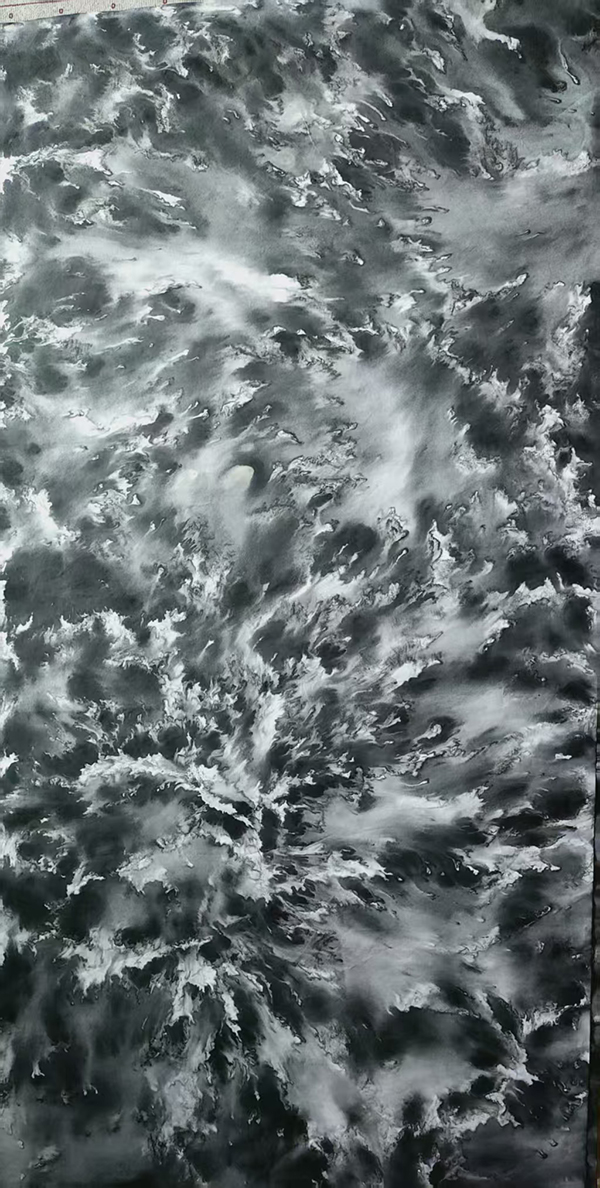
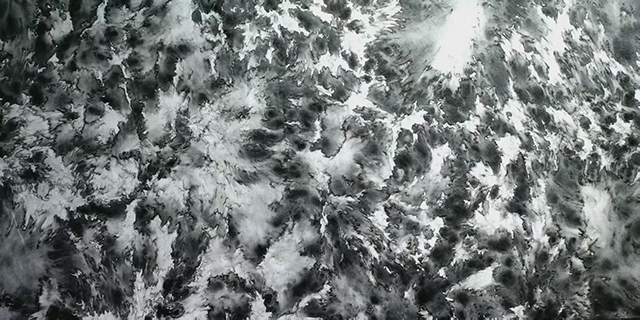
The Soul of the Universe seriesemploys ink painting, an ancient and ever-changing medium of the East, tocapture the ever-changing spectacle of the universe, the chaos and order ofnebulae, and the essential manifestations of life and consciousness on bothmicroscopic and macroscopic scales. This is an ambitious artistic goal thatdirectly shifts the artistic perspective from the "human world" tothe entire universe.
In terms of creative methodology,these works are clearly not mere reproductions of astronomical photographs.They employ an emergentism approach to creation. The artist simulates theevolution of cosmic matter under fundamental laws like gravity and repulsion bycontrolling the flow, diffusion, and interactions of ink on specific ricepaper. While the artist sets parameters for ink concentration, water ratio,paper texture, and initial brushstrokes, the final image formed on rice paperemerges as a result of chance and self-organization. In this process, theartist serves as both initiator and observer, engaging in a"dialogue" with the material's properties. Within uncontrollableconditions, they seek controllable opportunities, allowing order to emerge fromchaos.
The ultimate value of thisartistic process lies not in whether the work "resembles" a specificnebula, but in its successful visualization of the dynamic, complex, andmagnificent nature of cosmic evolution—emergence—on a two-dimensional plane.What it seeks is structural authenticity, processual isomorphism, and spiritualresonance. When viewers encounter such works, they no longer perceive specificnarratives or concepts, but rather a profound reverence for cosmic creativity,awe at life's complexity, and contemplation of the mysteries of consciousness.This transcends cultural and linguistic boundaries, offering a deeply movingaesthetic experience. Thus, The Soul of the Universe is not merely a series ofpaintings, but a philosophical manifesto.
Emergentism art innovatespractice with concrete artistic paradigm, and shows how emergentism art cancontinue to promote the process of human beings using wisdom and materials toform harmonious coexistence and complete high-dimensional artistic creation,and produce works with aesthetic impact.
The grand narrative is not basedon myth or ideology, but on philosophical cognition and contemporary science'sunderstanding of the universe.
Reconstructing the Aesthetics andthe Sublime:This kind of beauty is not sweet and decorative, but a kind of rational,structural, full of guiding and elevating spiritual realm "philosophicalbeauty" and "scientific beauty".
To Give the Material Life Vitality:letthe ink not only be the expression tool, but also become the "actor"participating in the creation, to make the Eastern ink art transcend thetraditional limitations, and give it a new life vitality of modernization andinternationalization.
Through such practice,emergentism art paints a blueprint distinct from the mainstream of contemporaryart. It neither retreats inward into personal trivialities nor dissipatesoutward in boundless social life, but rather gazes upward at the stars andprobes downward into the roots of existence, striving to find a more solid andgrand coordinate for art.
III Comparison and Transcendence:
HowEmergent Art Leads New Innovation Trends
By juxtaposing the conceptualparadigm of emergentism art with the contemporary art dilemmas discussedearlier, we can clearly discern a potential trajectory from "twilight"to "dawn." Rather than completely negating the achievements ofcontemporary art, emergent art offers a novel and more constructive solution toseveral fundamental issues, thereby revealing possibilities for transcendingcurrent challenges. This transcendence manifests across multiple dimensions,including worldview, spiritual dimensions, creative paradigms, and artisticvalues.
3.1 From "Deconstruction" to "Construction": FundamentalDifferences in Worldview
Contemporary art is largely aproduct of postmodernist thought, with "deconstruction" as one of itscore principles. It seeks to dismantle all centers of authority, grandnarratives, and constructs, exposing the artificiality and falsity behindlanguage, power, and knowledge. This critical deconstruction held immenseliberating significance during specific historical periods, freeing art fromrigid aesthetic standards. However, when deconstruction becomes an inertia andthe sole political correctness, it plunges into nihilism and cynicism. Afterendless deconstruction, what remains is often a wasteland of meaning. In thefreedom of "anything goes," people paradoxically lose the veryfoundation that sustains art.
Emergentism art signifies apivotal shift from 'deconstruction' to 'construction.' Rather than reverting topre-modern grand narratives rooted in myth or religious dogma, it endeavors toconstruct a new 'grand narrative' —one grounded in scientific rationality andsystematic thinking—on the ruins of postmodernism. Here's a comparison:
Comparison 1: The Origin ofMeaning.In contemporary art practices, meaning is subjectively imposed, culturallyencoded, and perpetually subject to questioning and deconstruction. emergentismart, however, posits that meaning is intrinsic to the universe, arisingobjectively from complex systems. The beauty of a snowflake, for instance, isnot a product of human subjective projection but a complex order emergingthrough the iterative application of physical laws. The essence of life liesnot in external purposes but in its emergent process of overcoming entropy,sustaining and developing complexity. Thus, the "construction" inemergentism art is not arbitrary fabrication but the "discovery" and"manifestation" of inherent, profound meaning patterns within thecosmos.
Comparison Two: WorldviewPerspectives. Deconstructivism'sworldview is fundamentally skeptical, critical, and fragmented, emphasizingdifferences, ruptures, and incommensurability. In contrast, emergentism'sworldview is integrative, interconnected, and holistic. Through the lenses offractals, chaos, synchronization, and self-organization, it reveals profound,cross-scale intrinsic connections between all things—from atoms to galaxies,cells to societies. It no longer views humans and nature, mind and matter,subject and object as binary opposites, but rather as a unified, co-evolvingcomplex system. This worldview provides art with a powerful philosophical toolto bridge the divisions caused by modernity, such as the rift between humansand nature and the divide between science and humanities.
Thus, emergentism art can be seenas a profound "sublation" of postmodern deconstructionist thought.While embracing deconstruction's critique of monocentric and rigid systems, itrefuses to remain in the pleasure of dismantling, instead courageouslyundertaking the task of constructing the "post-deconstruction era."It reminds us that even in an age where God is dead and grand narratives haveended, we can still find a solid anchor of meaning and a spiritual home withinthe universe's own complexity and grandeur.
3.2 From the Human World to the Cosmology: Reconstruction of the SpiritualDimension
As previously noted, thecontemporary art movement's growing emphasis on "lifelikerepresentation" and "secularization" has narrowed its focusexcessively to the "secular realm" —social issues, politicalconflicts, identity struggles, and the joys and sorrows of daily existence.While this undoubtedly fulfills art's essential function, when its entire scopebecomes confined to such themes, it loses the capacity to offer transcendentexperiences and ultimate concerns, ultimately resulting in the spiritualdimension's gradual atrophy.
Emergentism art powerfullyaddresses this crisis by expanding the artistic framework from the "humanworld" to a "cosmological perspective." It repositions"nature" and "cosmos" as central themes in artisticcontemplation and expression—not as the 19th-century Romantic nostalgia forpastoral landscapes, but as a more profound and rational cosmic consciousnessgrounded in 21st-century philosophical and scientific understanding. Let us nowcompare:
Comparison 1: The Origin of theSense of the Sublime.In Kantian philosophy, the "sense of the sublime" arises from the aweand transcendence of human reason when confronted with nature's immense power(the sublime of force) and infinite expanse (the sublime of mathematics).Contemporary art has largely abandoned the pursuit of this sublime, evendismissing it as an outdated elitist sentiment. In contrast, emergent artoffers a modern path for its revival. Its sublime no longer stems solely fromthe grandeur of mountains, rivers, lakes, and seas, but from profound insightsinto cosmic laws: from the infinite transformation between simplicity and complexityin fractal geometry, from the dynamic equilibrium between order and chaos atthe edge of disorder, and from the miracle of life emerging from inorganicmatter. This is a "sublime of reason" and a "sublime ofwisdom," capable of simultaneously satisfying our thirst for knowledge andreverence for the mysterious.
Comparison Two: Art's ComfortingFunction.In an era of uncertainty, conflict, and anxiety, can art offer spiritualsolace? While many contemporary artworks provoke reflection by exposing socialwounds and the darker aspects of human nature, they often exacerbate ratherthan alleviate viewers' distress. Emergent art, however, provides a distinctform of comfort. It situates humanity's existential dilemmas within a broadercosmic evolutionary context, revealing that chaos, uncertainty, and mutationare not merely societal misfortunes but the fundamental forces driving cosmicinnovation. Our very existence is part of this cosmic emergence process, markedby struggle and creation. Though this perspective cannot resolve specificsocial issues, it cultivates a resilient cosmic consciousness that transcendspersonal joys and sorrows, granting profound peace and strength.
Through this elevatedperspective, emergent art powerfully counters the "mediocrity" and"fragmentation" plaguing contemporary art. Rather than mired in thequagmire of daily life, it invites us to look up at the stars and re-examinethe eternal questions of "who we are, where we come from, and where we areheaded" —questions that have been sidelined by postmodern cynicism. Thisis precisely the spiritual mission that art must fulfill in every era.
3.3 From "Concept First" to "Process Generation": Innovation ofCreative Paradigm
Contemporary art, particularlysince the advent of conceptual art, has established a paradigm of "ConceptFirst." The core mission of artists is now seen as proposing a novel andcritical concept, while the physical form and creative process of the artworkare regarded as secondary means to realize this concept. This paradigm hassignificantly liberated artistic media and forms, yet it has also introducedcertain issues: artworks tend to become dry and didactic, overly reliant ontextual explanations; the joy of the creative process and the expressive powerof materials are overlooked; and artists increasingly resemble project managersrather than creators who dance with their materials.
Emergentism art introduces a'processual generation' creative paradigm, which provides a crucialcounterbalance to the 'concept-first' approach. Here's a comparison:
Comparison 1: The RelationshipBetween Artist and Work.In the paradigm of "conceptual primacy," the artist holds absolutecontrol over the artwork, which serves as a visual embodiment of theirconceptual framework. Conversely, within the "process generation"paradigm, the artist and artwork engage in a collaborative dialogue. Whileestablishing initial rules and boundaries, the artist allows materials,algorithms, or systems to freely evolve, ultimately "growing" intothe final work. Throughout this process, the artist acts as both designer andlearner, drawing inspiration from unexpected outcomes emerging from the systemwhile continuously adjusting their strategies. This creative approachreintroduces "surprise" and "the joy of discovery,"transforming the creative process itself into a dynamic artistic endeavor.emergentism art begins to employ complexity science and emergent theory topropose a new understanding of authorship that replaces the postmodern notionof "the death of the author." The meaning of art emerges preciselyfrom these interactive relationships, representing a relatively objectivephenomenon.
Comparison Two: Perspectives onTechnology and New Media. Whilemany contemporary artworks employ new media (e.g., artificial intelligence,biotechnology) as tools to realize social or political agendas, emergent artfocuses on the inherent generative potential of these technologies. Ingenerative art, for instance, artists program algorithms to enable computers toproduce infinite, non-repeating visual patterns. Bio-art utilizes theself-organizing capabilities of biological systems (such as bacteria and slimemolds) for creative expression. These practices exemplify the emergentparadigm: artworks are no longer static, finished objects but dynamic,continuously evolving systems. This not only expands artistic formssignificantly but also fundamentally redefines our understanding of"works" and "creation."
The shift from "conceptualprimacy" to "process-generated" does not mean abandoning art'sintellectual dimension. On the contrary, it embeds thought more profoundlywithin the creative process and structure, rather than confining it to externallabels or explanatory notes. It brings ideas to life through visible andtangible emergent processes, revealing abstract philosophical and scientificprinciples. This represents a more sophisticated and art-ontologically groundedwisdom.
3.4 Transcending the Twilight of Contemporary Art: The Contemporary Value ofEmergent Art
Through comprehensive comparativeanalysis, we can clearly perceive the immense potential of emergent art totranscend the twilight of contemporary art. Its contemporary value andsignificance can be summarized as follows:
First, it represents arenewed fusion of scientific and humanistic spirits. Modernity is characterizedby the dichotomy between science and humanities. With its profound scientificfoundation, emergent art provides a viable pathway to bridge this divide. Itdemonstrates that cutting-edge scientific discoveries can not only serve assubjects for artistic expression but also function as philosophical engines forartistic innovation. This helps reconstruct a holistic, undivided culturalperspective in an era increasingly defined by technology.
Second, it establishes thepost-humanistic legitimacy for art. Contemporary art, having deconstructed alltraditional value foundations, has long grappled with a profound legitimacycrisis. emergentism art, however, anchors its value in the generative essenceof the universe, providing a more solid and universal foundation. Art's valueno longer depends solely on the discourse power of specific circles, but ratherstems from its profound isomorphism with cosmic creativity.
Third, it offers humanity anew wisdom to tackle complexity. We live in an "emergent age" markedby uncertainty, interconnectedness, and complex challenges. Traditional linear,top-down thinking is becoming obsolete. emergentism art, with its profoundinsights into self-organization, adaptability, and edge innovation, is not justan artistic paradigm but a worldview and methodology. Through art, it trains usto appreciate complexity, embrace uncertainty, and uncover macro-level orderfrom simple local interactions. This wisdom holds immeasurable value foraddressing global challenges like climate change and social transformation.
Conclusion
As we stand at the twilight ofmodern art's century-long evolution, reflecting on its glorious struggles, itbecomes clear that the creative momentum of an era dominated bydeconstructionism, conceptualism, and cynicism is waning. Art now stands at acrossroads demanding rebirth. This twilight in contemporary art serves as aprofound harbinger, heralding the end of one cycle and the dawn of a new era.
The crisis of contemporary artstems from its failure to construct a new world after dismantling the old.While it gained unprecedented freedom in the mire of the "humanworld," it consequently lost the height to gaze at the stars. It is preciselyin these weakest links of contemporary art that emergentism art demonstratesits robust vitality. Adopting a constructive stance, it distills a novelcosmology from the profound wisdom of complexity science. Liberating art fromthe narrow confines of anthropocentrism, it reconnects with the grand narrativeof the universe. By replacing the increasingly exhausted "ontologicalprimacy" model with a "process-generated" creative paradigm, itraises the banner of "neo-humanism," returning art to its creativeorigin of coexisting with matter and life.
Emergent art and the movement itembodies will transcend being merely a new style in contemporary art'sspectrum. More likely, it will emerge as the core driving force propelling thenext phase of artistic innovation. This movement paves the way for a"post-postmodern" artistic trajectory. On this path, art will nolonger settle for critiquing or parodying the world, but instead reclaim itscreative mission as the "second nature" —revealing the profound lawsgoverning the world through sensuous forms, and highlighting the intrinsicbeauty of cosmic creation.
The direction charted by emergentart—a synthesis of philosophy, science, and humanities, a spiritualreconstruction of "neo-humanism," and an art embracing complex emergence—standsas a beacon guiding contemporary art beyond its twilight. It will steer arttoward a new future, moving beyond endless introspection or outwarddissolution, and instead embracing this ceaselessly evolving universe withbroader vision and deeper wisdom. This is precisely the irreplaceablecontemporary value and epoch-making significance of emergent art at today'shistorical juncture. Though the twilight of contemporary art has grown dim, thebirth of emergent art illuminates the path toward a more magnificent dawn.
相关链接:
当代艺术暮色中的艺术创新:涌现主义艺术的价值与意义
The Unity and Integration of Metaphysics and Science: The Complementary Reconstruction Value of the I Ching and Complexity Theory and Quantum Science
形而上学对当前科学疑难问题的阐释:从《周易》哲学认知体系视角看量子实验中的“幽灵”现象
形而上学与科学的统一与整合: 《周易》与复杂性理论、量子科学互补重构的价值与意义
玄学与科学的优势互补与融合:《周易》数理体系与量子理论的相互完善与理论重构
Complementary Advantages and Integration of Metaphysics and Science: Mutual Improvement and Theoretical Reconstruction of the Mathematical System in I Ching and Quantum Theory
范毓周:玄学的科学化与科学的玄学化
范毓周教授抽象水墨画的周易美学精神
“笔墨当随时代”:简析范毓周涌现主义艺术作品
范毓周教授的艺术成就与探索之路
意大利艺术评论家评范毓周涌现主义艺术
浑然天成:范毓周对美学的经验之谈
墨韵中的宇宙灵魂交响曲:范毓周涌现主义作品《宇宙之魂》系列评析
范毓周艺术馆发布涌现主义艺术宣言
范毓周《宇宙之魂》:涌现的艺术与艺术的涌现
范毓周做客中国金融网:畅谈心境水墨艺术创新
范毓周心境水墨艺术全球巡展北京展启幕
范毓周当代心境水墨艺术全球巡展在北京启动