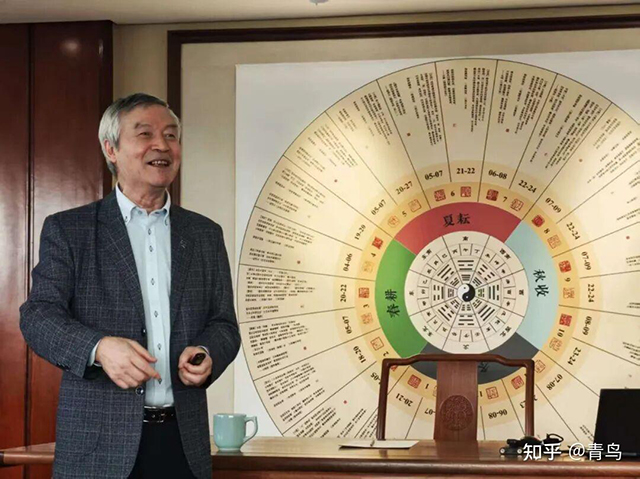
Abstract: This paperaims to explore the profound intrinsic connections and complementary valuesbetween the ancient Chinese philosophical classic "I Ching" (Bookof Changes) and modern frontier science, including complex systems theory andquantum science.
For centuries,Eastern wisdom epitomized by theI Ching has been regarded as metaphysics, seeminglybelonging to a cognitive paradigm distinct from Western science grounded inpositivism and reductionism. Yet with 21st-century scientific progress—particularly complexsystems theory's revelations of nonlinearity, emergence, and self-organization,and quantum mechanics' revolutionary interpretations of reality,interconnectedness, and observer effects—we have discovered striking structural parallels between the ancientworldview embedded in the I Ching and the cosmic visions depicted by thesescientific frontiers.
This paperfirst elucidates the core philosophical ideas of the Book of Changes andattempts to mathematically express them. It then delves into key concepts incomplex systems theory. Next, it examines the philosophical implications ofquantum science, particularly the phenomenon of quantum entanglement. Finally,through interdisciplinary comparative analysis and case studies (such asecosystems, financial markets, and urban transportation networks), itdemonstrates how these three elements form a complementary and morecomprehensive cognitive framework at the ontological, epistemological, andmethodological levels, offering a new theoretical perspective for understandingthe unity of the universe, life, and consciousness.
Keywords: I Ching,modern interpretation, complexity theory,quantum science, complementary reconstruction
I The Core Philosophical Concepts of I ching and Their ModernInterpretations.
As the"foremost among all classics and the source of the Great Dao," theI Chingis not merely adivination text but a philosophical masterpiece rich in profound cosmology andmethodology. Its central ideas transcend specific historical and culturalcontexts, offering a unique symbolic system and cognitive framework forunderstanding the complexity and dynamism of the world.
1,1 The Yin-Yang Dualism: A Dynamic Equilibrium and Complementary Opposition Theory
Thephilosophical cornerstone of I ching(theBook of Changes) is the Yin-Yang dualism. Yin (⚋) and Yang (⚊) are notmerely opposites but a unified entity characterized by mutual dependence,transformation, and dynamic equilibrium. The phrase "the interplay of Yinand Yang constitutes the Dao" reveals the fundamental law governing themovement and change of all things in the universe. Yang represents the forcesof positivity, luminosity, motion, and creation, while Yin embodies the forcesof negativity, darkness, stillness, and restraint. They serve as each other'sfoundationYang containsYin, and Yin harbors Yan,as depicted in the Taiji diagram. Throughperpetual interaction and transformation, they form a complete, self-regulatingsystem.
This conceptbears striking parallels to the "negative feedback" and"positive feedback" mechanisms in modern systems theory. A healthysystem—be it anecosystem or a social system—sustainsits stability and adaptability through the dynamic equilibrium of opposingforces. For instance, in ecosystems, the numbers of predators (yang) and prey(yin) maintain ecological balance through mutual restraint. Similarly, ineconomic systems, the "invisible hand" of the market regulates pricesand achieves dynamic resource allocation through the interaction of supply(yin) and demand (yang). Thus, the Yin-Yang theory is not merely aphilosophical speculation but also a universal model for describing the dynamicbehavior of complex systems.
1.2 The ThreeMeanings of "Yi": Change, Constancy, and Simplicity
The essence ofI Ching(the Book ofChanges) resides in the concept of "Yi," traditionally interpreted asthree meanings: Change (Yi): All things in the universe are in constant flux.This forms the core worldview of the IChing. The arrangement ofsixty-four hexagrams and three hundred eighty-four lines symbolizes theinfinite possibilities of change in diverse contexts. This profoundunderstanding of change aligns with modern science, particularly the entropyincrease process described by the second law of thermodynamics and thenonlinear dynamics principles in complex systems theory.
UnchangingPrinciples: Behind infinite transformations lie eternal laws and principles, the'Dao.' TheI ching employs itshexagram and line symbol system to reveal the fundamental patterns and ordergoverning all phenomena. This parallels modern science's pursuit of universalphysical laws (such as energy conservation and the mass-energy equivalenceequation), seeking simple yet profound unifying principles behind complexphenomena.
Simplicity:While the laws of the universe areprofound and intricate, their fundamental components and mechanisms remainsimple. TheI Chingemploys only two basic symbols, Yin (⚋) and Yang (⚊)to construct a sophisticated model that simulatesall phenomena through their combination and evolution. This embodies thephilosophy of 'the greatest truths are the simplest,' resonating with thescientific pursuit of the 'Occam's Razor' principle, which advocates explainingthe most extensive phenomena with the simplest model.
1.3 TheExploration of Symbolic Thinking and Mathematical Representation in theI Ching
TheI Ching is not merelya philosophical text; its "symbolic-numerical" system represents apre-scientific mathematical model. The combination of hexagrams (symbols) andline statements (numbers) forms a unique symbolic language system, used todescribe and predict the states and evolutionary trends of phenomena.
In the 17thcentury, German philosopher and mathematician Gottfried Wilhelm Leibniz made agroundbreaking discovery while studying the hexagram diagrams of theI Ching. He wasastonished to find that their sequence perfectly matched his newly developedbinary system. By interpreting the yang line (−) as 1 and theyin line (−−) as 0, he successfully converted all sixty-fourhexagrams into a binary sequence ranging from 0 (Kun) to 63 (Qian). Thisrevelation not only marked a significant convergence in the intellectualhistory of China and the West, but also unveiled the rigorous mathematicalstructure inherent in the I Ching's symbolic system for the first time.
In the 21stcentury, with the development of computer science, we can use more modernmathematical tools to interpret the Yin-Yang transformation of the Book of Changes.
BooleanAlgebra:By treatingyin and yang as logical 0s and 1s, the transformations of hexagrams and linescan be described as a series of logical operations. For instance, a six-linehexagram can be viewed as a six-digit binary number, and the process ofhexagram changes (line changes) can be interpreted as binary addition orbitwise operations. This provides a computational foundation for simulating theevolutionary process of the I Ching.
MatrixOperations:Thetransformation relationships among the sixty-four hexagrams can form a 64x64transition matrix. By applying matrix powers, we can predict the probabilitydistribution of a system evolving from any initial state (a specific hexagram)to other states after a series of steps. This provides a modern probabilisticframework to interpret the predictive function of theI Ching .
FractalGeometry and Self-Similarity:Thegenerative process from Yin and Yang to the Four Symbols, then to the EightTrigrams, and ultimately to the Sixty-Four Hexagrams, inherently embodiesself-similar structures. Each hexagram consists of two Jing hexagrams(three-line hexagrams), which in turn are composed of three lines. Thishierarchical nesting and the isomorphic relationship between parts and the wholeexemplify fractal principles. Fractal patterns are observed in naturalphenomena like coastlines, snowflakes, and the growth of tree branches,suggesting that the structure of the I Ching may profoundly reflect fundamentalcosmic configurations.
Through thismathematical interpretation, theI Ching is no longer merely a mysteriousdivination tool, but an abstract model that describes the dynamic evolution ofnonlinear, multi-level systems. It offers a systematic thinking approach basedon holistic pattern recognition, distinct from Western reductionist analysis.
II Complex Systems Theory: TheEmergence from Chaos to Order
The emergenceof complex systems theory in the latter half of the 20th century marked ascientific paradigm shift—from studying simple,linear, and predictable systems to investigating complex systems composed ofnumerous interacting units, characterized by emergent and self-organizingproperties. This theory provides a novel perspective for understanding naturaland social phenomena, resonating profoundly with the holistic and dynamicthinking of the I Ching.
2.1 CoreCharacteristics of Complex Systems
Complexsystems, such as ecosystems, financial markets, and urban transportationnetworks, typically exhibit the following features: A multitude of interactingcomponents. The system consists of numerous independent agents, each operatingunder simple rules.
Nonlinearity:The system's output is not proportional toits input. Even minor disturbances can be amplified, leading to significant anddisproportionate consequences, a phenomenon known as the "butterflyeffect."
Feedback loop:The system contains complex positive andnegative feedback loops, which make the system behavior difficult to predictand can realize self-regulation and adaptation.
Emergence: Complex,ordered collective behaviors at the macro level are not planned by centralcontrollers but emerge from simple interactions among numerous individuals atthe micro level. For example, ant colonies can construct intricate nests, yetno single ant possesses the complete blueprint.
Self-organization:The system can spontaneously evolve from adisordered state to an ordered structure and pattern without externalinstructions.
Thesecharacteristics are highly consistent with the world picture described in theI Ching.The sixty-four hexagrams in theI Ching are formed bythe interaction and combination of simple yin and yang lines, symbolizing thecomplex world generated from simple rules. The transformations betweenhexagrams and changes in line positions all reflect the nonlinear dynamics ofthe system and its sensitivity to initial conditions.
2.2 Chaos Theory and the "Butterfly Effect"
Chaos theoryreveals the inherent randomness within deterministic systems. A system's futurestate exhibits extreme sensitivity to its initial conditions, making long-termpredictions impossible. This aligns with the "change" concept in theBook of Changes—the world isfluid and the future is uncertain. The divination function of the Book ofChanges does not provide a deterministic or fatalistic answer, but ratherreveals various possibilities and latent trends of evolution under currentconditions. It emphasizes the importance of "timing" and"position" —that is,taking action at the right moment (time) and place (space/situation). A minoreffort (line change) may trigger a fundamental shift in the entire situation(hexagram), which is precisely the philosophical embodiment of the"butterfly effect."
2.3 Fractal Geometry: Self-Similar Fractal
Theory acrossScales Studies geometric shapes that exhibit similar structures at differentscales. As mentioned earlier, the hexagram structure of the I Ching inherentlypossesses fractal characteristics. The Eight Trigrams consist of three lines,and the Sixty-Four Hexagrams are formed by superimposing two trigrams. Thisholistic philosophy of "the whole containing the part and the partreflecting the whole" is a significant feature of traditional Chinesephilosophy. The phrase "drawing near from the body and drawing far fromthe world" in the Commentary on the Attached Phrases precisely illustratesunderstanding cosmic laws through observing and analogizing phenomena atdifferent scales. Fractal geometry provides a rigorous mathematical model forthis ancient cosmology of "correspondence between heaven andhumanity" and "oneness of all things," demonstrating howmicroscopic rules can be reproduced at larger scales, thereby constructing acomplex yet harmonious cosmic order.
2.4 Emergence and Self-Organization:
The core ofthe theory of ordered complex systems lies in "emergence" advanced,ordered macro patterns spontaneously emerge from simple interactions among lower-levelentities. This aligns with the Taoist principle of "the Dao followsnature" and the "governance through non-action" concept in theBook of Changes. An ideal system (whether in state governance or ecosystems)derives its order not from external coercion, but from the dynamic equilibriumspontaneously formed by internal elements following their inherent laws("the principle of constancy"). For instance, life itself representsthe most remarkable emergence phenomenon, where countless non-living moleculesself-organize to form conscious and intelligent organisms. The sixty-fourhexagrams and their transformation patterns in the Book of Changes can be seenas a classification and summary of various emergent patterns in the universe,depicting an evolutionary path from chaos (e.g., the initial difficulty of the"Tun" hexagram) to order (e.g., the harmonious interaction betweenheaven and earth in the "Tai" hexagram).
III The Enlightenment of QuantumScience: Entanglement, Superposition andHolism.
If the theoryof complex systems resonates with the systematic thought of theIChingat the macro level, thenquantum mechanics subverts the classical view of matter and reality at themicro level, and its philosophical implications are more deeply aligned withthe cosmic vision of theI Ching.
3.1 From Classical Physics to Quantum Mechanics: A Paradigm Shift in Worldview
The Newton-Descartes paradigm of classical physics depicts the world as a massive,predictable mechanical clock, where matter consists of isolated, solidparticles and spacetime serves as an absolute backdrop. However, the emergenceof quantum mechanics has completely overturned this image. It reveals amicroscopic world composed of probability waves, uncertainty, and intrinsic correlations.At the quantum level, the universe is no longer a collection of discretecomponents but an indivisible, dynamic network of interconnected entities.
3.2 Quantum Entanglement: The "Phantom Telepathy" and Holistic Nature.
Quantumentanglement, one of the most peculiar and philosophically profound phenomenain quantum mechanics, occurs when two or more particles are in an entangledstate. They form an indivisible whole, and measuring one particle instantlyaffects the state of the other, regardless of their distance. Einstein famouslydescribed this phenomenon as "phantom telepathy."
This phenomenon poses a formidable challenge to the "local realism" ofclassical physics. It demonstrates that the universe's fundamental structure is"non-local" —no entityexists in isolation, as all things are interconnected at a fundamental level.This aligns perfectly with the holistic cosmology articulated in the Commentaryon the Book of Changes: "The I Ching (Book of Changes) corresponds toheaven and earth, thus comprehending the principles of the cosmos." TheBook of Changes embodies a relational ontology, asserting that the meaning andnature of things are determined by their positions and interactions withinrelational networks, rather than their inherent attributes. Quantumentanglement provides striking modern scientific evidence for this ancientholistic intuition. The universe is not constructed from "bricks,"but rather resembles an immense, interconnected "web."
3.3 Superposition, Wave Function Collapse, and Observer Effect
Quantummechanics describes a particle's state as asuperposition 'where it can exist in multiplepossible states simultaneously before measurement. For instance, an electronmay occupy multiple positions at once. The state only collapses into a definitevalue upon measurement. More importantly, the act ofobserving itself participates in the process ofreality creation.
This bearsprofound analogies with the divination process in the Book of Changes. Thesixty-four hexagrams represent all prototypical possibilities of development(superposition states). When the diviner performs yarrow stalk divination(equivalent to "measurement") with sincere intent (specific mentaland energetic states), a particular hexagram is "selected" and"collapsed" from all possibilities into the present reality. Thissuggests that there may be a far deeper interactive relationship betweenconsciousness (the observer) and the material world than classical physicspresupposes. The wisdom of the Book of Changes lies in its refusal to view thefuture as predetermined, but rather as a field of possibilities shaped bycurrent conditions and human subjective initiative.
3.4 Quantum Field Theory and the Monism of "Qi":The Frontier ofModern Physics
Quantum FieldTheory (Quantum Field Theory)further deepens this holistic view. It posits that the mostfundamental constituents of the universe are not particles, but rather"fields" permeating all of space-time. Particles are merely excitedstates of these fields, akin to ripples on water. This implies that"emptiness" is not absolute void, but rather a substrate brimmingwith potential and vitality. This closely resembles the monism of"Qi" in ancient Chinese philosophy. "Qi" is the most basicmaterial and energy that constitutes all things in the universe; it coalescesinto form and disperses into Qi, with all phenomena manifesting throughdifferent vibrational modes and condensation states of "Qi." The twoyin-yang lines in the I Ching can be understood as the two fundamental modes ofmotion and condensation of "Qi." Therefore, from the perspective ofquantum fields, the yin-yang transformations described in the I Ching representthe ceaseless generation and transformation of cosmic energy fields into allthings.
IV Cross-boundary Dialog: ComplementarityAnalysis of the,Complexity and Quantum Mechanics
When wejuxtapose these three seemingly disparate knowledge systems, we find that theyare not mutually exclusive, but rather describe the same complex, dynamic, andholistic universe at different levels, forming a profound complementaryrelationship.
Core concepts | I Ching philosophy | Complex system theory | Quantum science |
Ontology | The Unity of Qi and the Ontology of Relations | The system consists of interacting agents. | Quantum field, Nonlocal subject |
Worldview | Organic, Holistic, Dynamic Generation | Emergence, Self-organization, Nonlinearity | Probability Theory, Correlation, Uncertainty |
Elementary unit | Yin(--), Yang(-) | Agent | Quanta, Wave function |
Core power | Yin-Yang interaction, Life never stop | Feedback loop, Adaptation, Evolution | Evolution and Collapse of Wave Function |
Structural models | Archetypes, Fractal structure | Superposition, Fractal, Network | Superposition state, Entangled state |
Epistemology | Harmony relations between Heaven and Man, Macroscopic Realization | The whole is greater than the sum of its parts | The Observer Participates in the Construction of Reality |
4.1 Holism and Interconnection
From "Harmony Between Heaven andHumanity" to Quantum Entanglement. The I Ching's concept of"Harmony Between Heaven and Humanity" underscores the profound unitybetween humans and nature. Complex systems theory, through studies ofSocial-Ecological Systems (SES), reveals the inseparable interdependencebetween human society and the natural environment. Quantum entanglement, at themost fundamental physical level, demonstrates non-local holism. Together, thesethree perspectives converge on a conclusion: fragmented and isolated viewpointsare limitations in understanding the world. True comprehension arises fromgrasping the interconnections among system components and the interactionsbetween systems and their environments.
4.2 Dynamic Generation and Evolution: From "Endless Vitality" toSelf-Organizing Emergence
TheCommentary on the Hexagrams states: "The perpetual creation is called Yi(Change)." The Book of Changes depicts a cosmic process of continuouscreation and eternal transformation. The core principles of complex systemstheory—emergence and self-organization—perfectly illustrate this "endlessvitality" mechanism: how simple fundamental rules spontaneously generateentirely new, higher-order structures and behaviors without central control.From the origin of life to the emergence of consciousness, and the evolution ofcivilization, all these phenomena exemplify this dynamic generative process.
4.3 Patterns and Archetypes: From "Hexagrams" to Fractal and Attractor
The Sixty-Four Hexagrams are not staticdepictions of concrete entities, but rather abstract representations of typicalpatterns or "Archetypes" in dynamic processes. Each hexagram embodiesa specific context, developmental stage, or dynamic relationship—mirroring theconcept of "Attractor" in complex systems. An Attractor denotes astable state or behavioral pattern that a system tends toward during prolongedevolution. Both chaotic and periodic Attractors, much like the hexagrams,provide structural frameworks for understanding seemingly random complex systembehaviors. Similarly, the self-similarity inherent in fractal geometryresonates with the I Ching's philosophy of "Great Images have noform yet their images exist" —a principle that reveals how macroscopic andmicroscopic phenomena follow analogous organizational principles.
V Case Analysis: Application of Theoretical Mapping in theReal World
5.1 Natural Science Case: Evolution and Resilience of Ecosystems. Ecosystems aretypical complex adaptive systems
From the perspective of the Book ofChanges, we can understand ecological balance through the Yin-Yang theory. Forinstance, the dynamic cycle of matter and energy between producers (plants),consumers (animals), and decomposers (microorganisms) embodies the interdependenceof Yin and Yang. A healthy ecosystem exists in the state of "Tai"(harmony between heaven and earth, unimpeded flow), where energy circulatessmoothly. When faced with external disturbances (such as climate change orspecies invasion), the system may enter states of "Fei" (disruptionbetween heaven and earth, stagnation) or "Jian" (adversity). Thesuccession process of ecosystems, such as the transition from bare land toforest, can be symbolically described through the evolution of hexagrams, illustratingits phased characteristics and transformation logic.
From the perspective of complex theory,phenomena such as species diversity, food web structure, and trophic cascadesin ecosystems are all emergent. The system's "resilience" , its ability to recover fromdisturbances—depends on the complexity and redundancy of its internalconnections. The disappearance of a key species may trigger a "tippingpoint," leading to irreversible changes in the system's state, which is ahallmark of nonlinear dynamics.
The complementary value: The hexagramsystem of the Book of Changes provides a conceptual framework and philosophicalmetaphor for understanding the "qualitative changes" in ecosystemstates, while complex systems theory offers quantitative models and analyticaltools (such as network analysis and agent-based modeling) to precisely describethe processes and mechanisms of these changes. This combination enables us toboth grasp the macroscopic "climate" of ecosystems and delve intotheir microscopic dynamics.
5.2 Social Science Case Study: Volatility and Forecasting in Financial Markets
Financial markets are complex adaptivesystems shaped by collective human behavior, characterized by inherentuncertainty and irrational elements.
From the perspective of the Book ofChanges: The "greed" (yang) and "fear" (yin) in marketsentiment are the two fundamental forces driving market cycles. The alternationbetween bull markets (as symbolized by the Qian hexagram, where the dragonsoars in the sky) and bear markets (as represented by the Kun hexagram, wherefrost hardens the ice) reflects the cyclical waxing and waning of yin and yang.Market turning points often occur at the moment when "extremes must bereversed." For instance, after the Bo hexagram (complete shedding) comesthe Fu hexagram (a new yang returns), heralding the beginning of a new cycle.
From the perspective of complex theory, the"herd effect" in financial markets is a classic example of positivefeedback self-organization. Phenomena such as dramatic price swings andlightning crashes reflect the system's inherent nonlinear dynamics and chaoticbehavior. The fractal theory, widely used in technical analysis, seeks toidentify self-similar patterns across different time scales within seeminglyrandom price fluctuations.
Complementary Value: The I Ching offersprofound insights into the psychological dimensions and cyclical rhythms offinancial markets that are difficult to quantify. It reminds us to focus on the"momentum" of system states rather than merely the"numbers" of prices. Complex theory provides mathematical models forthese phenomena, such as simulating how trader interactions emerge asmacro-level market behaviors through multi-agent simulations. Integrating thewisdom of the I Ching with complex financial models holds promise fordeveloping more robust and forward-looking risk management and investmentstrategies.
5.3 Technology and Engineering Case: Self-organization and Optimization of UrbanTraffic Networks
Urban traffic networks are a classicsocio-technical complex system, where efficiency and congestion are jointlydetermined by the collective decisions of countless individuals.
From the perspective of the Book ofChanges, traffic flow can be viewed as the movement of "Qi." Unimpededflow embodies the "Tai" hexagram, while congestion symbolizes the"Jian" or "Kun" hexagrams. The goals of urban planning andtraffic management are to facilitate the smooth circulation of "Qi"and prevent congestion. This requires balancing strategies of"openness" (yang, such as building new roads) and"blocking" (yin, such as traffic control) to achieve a dynamicequilibrium.
From the perspective of complex theory,traffic congestion represents a classic case of "phase transition"and emergent phenomena. When vehicle flow exceeds a critical density threshold,the initially free-flowing "gas" state abruptly transforms into acongested "solid" state. This transition occurs spontaneously throughdriver interactions (e.g., deceleration and lane changes) rather than beingcommanded by centralized authorities. Network science and fluid dynamics areemployed to analyze and optimize the structure and efficiency of transportationnetworks.
Quantum Science's Enlightenment: Whilequantum mechanics cannot be directly applied to macroscopic traffic systems,its concept of "superposition states" can inspire innovativeoptimization algorithms. For instance, the "quantum annealing"algorithm can simultaneously explore multiple potential solutions to a problem,thereby identifying the global optimal solution. This approach holds tremendouspotential for solving complex traffic path planning problems (NP-hardproblems), mirroring the I Ching's philosophy of seeking the"central and balanced" path among diverse possibilities.
Complementary Value: The philosophy of theI Ching provides macro-level guiding principles, emphasizing the wisdom of"integration" and "adaptability." Complex systems theoryoffers analytical tools to help us understand congestion formation. Emerging technologieslike quantum computing may provide disruptive computational capabilities toaddress these highly complex challenges. The integration of these threeapproaches points the way toward building smarter, more adaptive "smartcity" transportation systems.
VI. Reflections on History and Philosophy: Confluenceof Cognitive Paradigms in the East and the West
The opposition between metaphysics andscience is largely due to the difference of the philosophical tradition betweenthe East and the West.
6.1 The Reductionist Tradition in Western Science
Fromthe ancient Greek atomic theory to Newtonian mechanics and modern biology'sgene-centric paradigm, reductionism has remained the dominant paradigm inWestern science. Its core principle involves understanding the whole bydecomposing complex systems into their smallest components. While this approachhas achieved remarkable success over centuries, it has also revealedlimitations when dealing with highly complex systems such as life, consciousness,and society. It often overlooks the "emergent" properties arisingfrom interactions between parts, namely the phenomenon where "the whole isgreater than the sum of its parts."
6.2 In Contrast to the Holistic Thinking of Eastern Philosophy
The traditional Chinese philosophyrepresented by the I Ching has maintained an organic and holisticworldview from the very beginning. It focuses not on isolated"entities," but on "relationships," "processes,"and "patterns." It does not ask "what it is," but rather"how it changes" and "how it relates to each other." Thisway of thinking emphasizes context ("time" and "position"),dynamic equilibrium (yin and yang), and cyclical evolution (the Five Elementsand the sequence of hexagrams), which naturally makes it conducive to the studyof complex systems.
6.3 Paradigm Shift: From Fragmentation to Integration Since the Late 20thCentury
Science has undergone a profound paradigmshift. The emergence of complex systems theory and quantum mechanics marked amajor breakthrough from classical reductionism. Scientists increasinglyrecognize that understanding real-world complexities requires a systemic andholistic approach. As physicist David Bohm proposed, the universe's essence maybe an indivisible whole, with the perceived separation of worlds being merely aprojection of its "implicate order."
In 2025, we observe a growing trend ofinterdisciplinary research drawing upon the wisdom of Eastern philosophy. Some scientists of Neuroscience have discovered self-organizing principlesakin to the "Dao" while studying brain networks; ecologists apply theconcept of yin-yang balance when constructing sustainable development models;and AI researchers are exploring computational paradigms that transcend logicaloperations, aligning more closely with intuition and epiphany. This is not merecultural appropriation, but rather a reflection of how modern science'sexploration of the universe's deepest mysteries now finds its conclusionsresonating with the intuitive insights of ancient wisdom.
Conclusions and Prospects
Through a systematic examination andcomparative analysis of the philosophy of the Book of Changes, complex systemstheory, and quantum science, this study reveals profound intrinsic isomorphismsand complementary values among these three disciplines. We demonstrate thatIChing (the Book of Changes) is not merely metaphysics but also a sophisticatedmodel of complex systems. Its dualistic yin-yang theory, concept of change, andsymbolic-numerical framework provide a timeless philosophical framework andsymbolic tool for understanding nonlinear, dynamically evolving systems. Themathematical potential of the Book of Changes—from Leibniz's binary system tomodern computational simulations—is being continuously explored.
The theories of complex systems and quantumscience offer modern scientific interpretations of IChing . Concepts such as chaos, fractals, andemergence provide concrete scientific mechanisms for the dialecticalrelationship between "change" and "constancy" in I Ching the Book of Changes. Quantum entanglement,superposition, and the observer effect offer unprecedented theoretical supportfor the holistic cosmology and the "correspondence between heaven andhumanity" concept in the Book of Changes.
The integration of these three elementspoints to a new and more comprehensive scientific paradigm: this paradigmtranscends the binary oppositional mindset between East and West, combining theholistic and intuitive wisdom of the East with the analytical and empiricalmethods of the West. It is capable of handling both the precise calculations of"hard" science and accommodating the complexity of "soft"issues (such as consciousness, values, and meaning).
Looking ahead, this interdisciplinaryresearch field is brimming with limitless possibilities. We anticipate thatfuture studies will delve deeper into: developing complex system modelingalgorithms based on the principles of the I Ching; leveraging the logicof hexagram and line changes to provide novel algorithmic insights for fieldssuch as artificial intelligence, financial forecasting, and climate modeling.
Exploring the direct connections betweenquantum phenomena and macroscopic complex systems (particularly life systems):investigating whether quantum entanglement and coherence play pivotal roles inmacroscopic emergent phenomena such as biological photosynthesis, aviannavigation, and even human consciousness, thereby providing a more robustphysical foundation for the concept of "harmony between heaven andhumanity".
Construct an integrative "systemphilosophy" that combines Eastern wisdom with modern science to providenew worldviews and methodologies for addressing global complex challenges suchas climate change, social fragmentation, and spiritual crises.
In conclusion, metaphysics and science arenot eternal adversaries. At the forefront of human knowledge, they areunexpectedly converging once more. The ancient wisdom classic I Ching(Book of Changes), illuminated by complex theories and quantum science, isregaining new vitality. Its holistic, dynamic, and interconnected cosmologywill provide invaluable insights and guidance for 21st-century scientificexploration and the sustainable development of human civilization. This greatunification may well be just beginning.
Fan Yuzhou: Professor andDoctoral Supervisor of Nanjing University;Member of theExpert Committee of the Ancient Civilization Research Center at the ChineseAcademy of Social Sciences;DistinguishedProfessor at the China Center for Sustainable Development Research at PekingUniversity;InternationalProject Leader of the Silk Road Culture Laboratory at Renmin University ofChina。
相关链接:
形而上学对当前科学疑难问题的阐释:从《周易》哲学认知体系视角看量子实验中的“幽灵”现象
形而上学与科学的统一与整合: 《周易》与复杂性理论、量子科学互补重构的价值与意义
玄学与科学的优势互补与融合:《周易》数理体系与量子理论的相互完善与理论重构
Complementary Advantages and Integration of Metaphysics and Science: Mutual Improvement and Theoretical Reconstruction of the Mathematical System in I Ching and Quantum Theory
范毓周:玄学的科学化与科学的玄学化
范毓周教授抽象水墨画的周易美学精神
“笔墨当随时代”:简析范毓周涌现主义艺术作品
范毓周教授的艺术成就与探索之路
意大利艺术评论家评范毓周涌现主义艺术
浑然天成:范毓周对美学的经验之谈
墨韵中的宇宙灵魂交响曲:范毓周涌现主义作品《宇宙之魂》系列评析
范毓周艺术馆发布涌现主义艺术宣言
范毓周《宇宙之魂》:涌现的艺术与艺术的涌现
范毓周做客中国金融网:畅谈心境水墨艺术创新
范毓周心境水墨艺术全球巡展北京展启幕
范毓周当代心境水墨艺术全球巡展在北京启动