Image source: Network
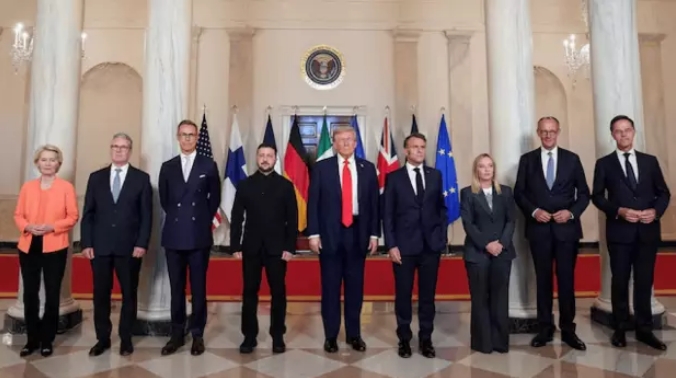
On August 18th, local time, U.S. PresidentTrump held a highly anticipated multilateral meeting in the East Room of theWhite House with Ukrainian President Zelenskyy and several key Europeanleaders. Amid the warm glow of the Oval Office fireplace and the radiantsplendor of the East Room's crystal chandeliers, one solemn yet hopeful worddominated the agenda: peace. President Trump clearly stated that the protractedand brutal war between Russia and Ukraine "should be resolved through apeace agreement," not merely a fragile ceasefire. He revealed that RussianPresident Putin had, in principle, agreed to accept some form of securityguarantee for Ukraine, emphasizing that European nations would bear the"primary responsibility" in this framework, while the United Stateswould "assist them."
This series of high-level interactionsseems to bring a glimmer of hope for peace to a Ukraine ravaged by war.However, in this faint light of hope, a historical specter—the ghost of theBudapest Memorandum on Security Assurances—is haunting the corridors of powerin Kyiv, Brussels, and Washington. This thirty-year-old story of promises andbetrayals is not only the most profound trauma in Ukraine's modern history butalso serves as a stark, even bloody, warning for any current efforts aimed atending the conflict.
History is filled with peace treaties—somelong, some short, some successful, some failures. Together, they form achronicle of humanity's search for order and stability, a search often thwartedby power, ambition, and treachery. From ancient times to the present, examplesabound of the ink on a treaty barely drying before the drums of war beat again,tearing the agreement to shreds. These historical ruins warn us that thefragility of a piece of paper often stands in stark contrast to the grand peaceit promises. Any peace agreement detached from the reality of power, lacking arobust enforcement mechanism, and built on wishful thinking about an aggressor'sgoodwill is highly likely to become a carefully laid trap, setting the stagefor a larger conflict.
Therefore, as the world's attention focuseson the peace initiative from the White House, we must learn from history,deeply analyze the inherent vulnerabilities of peace agreements, and hold upthe Budapest Memorandum on Security Assurances as the most central and painfullesson to be examined. Only by doing so can we ensure that a futureRusso-Ukrainian peace agreement does not repeat the same mistakes, preventingUkraine from once again falling into the "Budapest trap" of tradingnational sovereignty for false promises.
The Illusions of Peace: From Versaillesto Munich
The signing of a peace treaty isessentially a compromise reached after calculating the costs and benefits ofconflict within a specific power structure. However, power dynamics are fluid,and national intentions can change, while human greed and fear are eternal.This makes any peace agreement inherently fragile.
The Treaty of Versailles (1919) after WorldWar I is a classic example. It aimed to build a lasting peace by imposing harshpunishments on Germany—including massive war reparations, territorialconcessions, and strict military restrictions. However, this logic of a "punitivepeace" was deeply flawed. Not only did it fail to completely destroyGermany's capacity to wage war again, but it also deeply humiliated the entireGerman nation, creating fertile ground for the rise of Nazism and fueling apotent desire for revenge. Furthermore, the treaty's enforcement was riddledwith loopholes. Divisions quickly emerged among the victorious powers, and theU.S. Senate's refusal to ratify the treaty deprived the League of Nations, itscornerstone, of its most powerful backer, severely weakening its authority andability to enforce the terms. Ultimately, the Treaty of Versailles brought notpeace but what historians have called a "twenty-year armistice."
If the lesson of Versailles was"excessive punishment," the 1938 Munich Agreement represents theopposite extreme—the "catastrophe of appeasement." At that time, toavoid war with Hitler's Nazi Germany, Britain and France chose to sacrifice theinterests of Czechoslovakia, agreeing to cede the Sudetenland to Germany. Uponhis return from Munich, British Prime Minister Neville Chamberlain waved theagreement signed with Hitler and proudly declared he had brought "peacefor our time." However, this "peace," built on a misjudgment ofthe aggressor's ambitions and a betrayal of an ally, was a complete illusion.Hitler saw the Anglo-French compromise as a sign of weakness. Just six monthsafter annexing the Sudetenland, he brazenly sent troops to occupy the rest ofCzechoslovakia and, a year later, invaded Poland, triggering the Second World War.The Munich Agreement thus became a shameful byword in the history ofinternational relations, a profound illustration of the short-sightedness anddanger of appeasing an aggressor by sacrificing the sovereignty of anothernation.
Cold War-era arms control negotiations,such as the Strategic Arms Limitation Talks (SALT), while slowing theU.S.-Soviet nuclear arms race to some extent, were also fraught with acat-and-mouse game. Agreements often just shifted competition from restrictedto unrestricted areas. For example, limits on the number of intercontinentalballistic missiles spurred the development of multiple independently targetablere-entry vehicle (MIRV) technology and intermediate-range missiles. Thestability of these agreements relied more on the terrifying balance of"mutually assured destruction" than on genuine trust. Once thestrategic balance was upset, or one side saw an opportunity, the constraints ofthe agreement would quickly evaporate.
These historical cases, spanning differenteras and regions, all point to a core conclusion: the success of a peaceagreement does not depend solely on the elegance of its wording or thesolemnity of its signing ceremony. Its viability rests on three pillars:
1. The fairness and rationality of its terms, which must address the root causes of the conflict without sowing the seeds of revenge.
2. The effectiveness of the balance of power and deterrence, which must ensure that any potential violator faces unbearable consequences.
3. The reliability of monitoring and enforcement mechanisms, which requires a strong and determined third party to ensure compliance.
The absence of any one of these pillars cancause the entire edifice of peace to collapse. And it was on all three of thesepillars that Ukraine's Budapest Memorandum on Security Assurances had fatalstructural flaws.
The "Original Sin" andCollapse of the Budapest Memorandum
The dissolution of the Soviet Union in 1991brought the world the joy of the Cold War's end, but it also left behind thethorny issue of nuclear proliferation. As a newly independent state, Ukraineinherited the Soviet Union's vast nuclear arsenal, overnight becoming theworld's third-largest nuclear power with approximately 1,900 strategic nuclearwarheads. For a country just finding its footing—economically struggling andpolitically unstable—this was both a potential strategic bargaining chip and aheavy burden, accompanied by immense international pressure.
Amidst active mediation by the UnitedStates and Russia, complex negotiations began over the future of Ukraine'snuclear weapons. Ukraine's core demand was clear: it was willing to give up itsnuclear weapons, but only on the condition that its national independence,sovereignty, and territorial integrity were genuinely guaranteed by theinternational community, especially by the two nuclear superpowers, the U.S.and Russia. After several years of intense negotiations, on December 5, 1994,Ukraine, the United States, Russia, and the United Kingdom signed a historicdocument in Budapest, Hungary—the Budapest Memorandum on Security Assurances.
According to the memorandum, Ukrainepledged to relinquish all its nuclear weapons, transferring them to Russia fordismantlement, and to join the Treaty on the Non-Proliferation of NuclearWeapons (NPT) as a non-nuclear state. In return, the U.S., Russia, and the U.K.made six commitments to Ukraine, the core of which included:
To respect Ukraine's independence, sovereignty, and existing borders.
To refrain from the threat or use of force against Ukraine.
To refrain from using economic coercion against Ukraine.
To seek immediate United Nations Security Council action to provide assistance to Ukraine if it should become a victim of an act of aggression or an object of a threat of aggression in which nuclear weapons are used.
Not to use nuclear weapons against Ukraine.
To consult in the event a situation arises which raises a question concerning these commitments.
On the surface, this memorandum seemed toprovide a comprehensive security umbrella for Ukraine, allowing it to disarmwith confidence. However, the devil was in the details, particularly in thechoice of the word "assurances." During the negotiations, U.S. StateDepartment lawyers deliberately insisted on using "assurances" ratherthan "guarantees." In the context of English, these two words carrysignificantly different legal weight. A "guarantee" typically impliesa legally binding, automatically triggered military intervention, similar tothe collective defense clause of Article 5 of the NATO treaty. An"assurance," on the other hand, is a political commitment, weaker inits binding force, relying more on the goodwill and political will of thesignatories, and does not necessarily entail military involvement. Ironically,in Ukrainian and Russian, both words are often covered by the same term (гарантії/гарантии), which, to some extent, led to a misunderstanding or wishfulthinking on Ukraine's part.
The first "original sin" of thismemorandum lay in its ambiguous legal status and the weakness of itscommitments. It was not a formal international treaty requiring parliamentaryratification but a political-level memorandum of understanding. This"constructive ambiguity" may have been a necessary compromise toreach an agreement at the time, but it planted the seeds of betrayal from thevery beginning.
The second "original sin" was thelack of effective enforcement and punishment mechanisms. The memorandumstipulated "consultations" when problems arose, which is an extremelysoft response. If consultations failed, or if one party (especially Russia, apermanent member of the Security Council) refused to cooperate, the memorandumitself did not specify any automatic, concrete punitive measures. It onlymentioned seeking "United Nations Security Council action" in theevent of a nuclear attack on Ukraine, which, with Russia holding a veto, waspractically an empty phrase.
It was these inherent flaws that led to thedevastating breach of the Budapest Memorandum in 2014 when Russia annexedCrimea. At the time, Russian forces swiftly occupied the Crimean Peninsula. Inthe face of Ukrainian protests and international condemnation, Russia offered astunning explanation. President Putin claimed that a "revolution" hadoccurred in Ukraine in 2014, creating a "new state," and that Russia"had not signed any binding documents with this new state." TheRussian Foreign Ministry also argued that the security assurances were given tothe "legitimate government" of Ukraine, not to the "forces thatcame to power through a coup." This blatant distortion of internationallaw fully exposed its perfidy.
Faced with Russian aggression, the responseof the United States and the United Kingdom, as guarantors, fully demonstratedthe limitations of "assurances." They issued diplomatic condemnationsand imposed economic sanctions on Russia, and provided Ukraine with somefinancial and non-lethal military aid. However, they explicitly ruled out anydirect military intervention to avoid a direct confrontation with anuclear-armed Russia. While this response may be understandable from arealpolitik perspective, for Ukraine, it was undoubtedly a bankruptcy of thesecurity commitment. A report from the British House of Lords even criticizedits own government, stating that as a signatory to the memorandum, the UK was"not as active or visible as it could have been" when the crisiserupted.
If the 2014 Crimea incident was a heartattack for the Budapest Memorandum, then Russia's full-scale invasion onFebruary 24, 2022, was the declaration of its complete death. Russian forceslaunched a massive offensive from the north, east, and south, bombing majorcities in an attempt to overthrow its democratically elected government. Thiswas no longer a violation of a specific clause of the memorandum but a totalrepudiation of its spirit and all its core principles. Russian Foreign MinisterLavrov had made a ridiculous defense in 2016, claiming that "Russia hasnever violated the Budapest Memorandum. It contains only one obligation, not toattack Ukraine with nuclear weapons." In the face of the 2022 full-scalewar, this statement appeared even more pale and feeble.
The collapse of the Budapest Memorandum hasbrought disastrous lessons for the international community.
First, it has severely eroded thecredibility of the nuclear non-proliferation regime. Ukraine's experience sendsa dangerous signal to the world: giving up nuclear weapons in exchange forsecurity commitments from major powers is unreliable. This will undoubtedlyencourage countries in geopolitical hotspots and facing security threats (suchas Iran and North Korea) to more resolutely seek nuclear weapons, as they seethem as the only reliable guarantee of survival.
Second, it has exposed the fragility of theso-called "rules-based international order." When a permanent memberof the UN Security Council can openly tear up an international document itsigned and launch an invasion of a sovereign state, and the internationalcommunity is unable to effectively stop it, the authority of the entire body ofinternational law is severely undermined.
Third, for Ukraine, this is a lessonwritten in the blood of its people and the loss of its territory: never tradethe tangible strategic deterrent in your hands for verbal, vague, andnon-binding "promises" from others. This is the essence of the"Budapest trap."
Building a "Trap-Proof"Framework for Future Ukraine Peace
Let's return to the meeting at the WhiteHouse on August 18, 2025. President Trump's desire to promote a peace agreementis commendable, but the path to peace is far more complex than the rhetoricsuggests. Having experienced the profound pain of the "Budapesttrap," Ukraine and its allies are extremely wary of any new peace deal.President Zelenskyy stated clearly before flying to Washington: "We willnot accept a peace that hides a new war." He stressed that any agreementmust be built on "justice, sovereignty, and firm guarantees," not onthe illusion of a truce that conceals future invasions.
So, how can we design a framework for apeace agreement that avoids repeating past mistakes and genuinely bringslasting, just peace to Ukraine? This requires a multi-layered, high-strengthsecurity architecture that goes beyond traditional peace treaties, with itscore objective being to completely block all paths leading to the"Budapest trap."
First: From "Vague Promises"to "Ironclad Guarantees"—The Legalization and Militarization ofSecurity Guarantees.
A future peace agreement must completelyabandon ambiguous political terms like "assurances" and replace themwith legally binding "guarantees." These guarantees cannot be merereiterations of the principles of the UN Charter on the non-use of force; theymust be customized, operational, and automatic security provisions for Ukraine.
As some European leaders have suggested,the ideal model is a "NATO Article 5-like" collective securitycommitment. This means that a core group of nations (e.g., the United States,the United Kingdom, France, Germany) would sign a formal, parliamentary-ratifieddefense treaty with Ukraine. The treaty should explicitly state that anyunprovoked aggression against Ukraine will be considered an attack on thesecurity of all guarantor nations, obligating them to take immediate action,including the direct deployment of troops, to restore Ukraine's sovereignty andterritorial integrity.
In the August 18th talks, while PresidentTrump did not explicitly promise to send U.S. troops, he stated that the U.S.would "participate" and "help" European nations provide"very good security guarantees" for Ukraine and ensure that the peaceis "long-term." This leaves room for building such a strong guaranteesystem. The key is that this "participation" and "help"must be clearly written into a legally binding text to avoid any strategicambiguity.
Second: From "PassiveConsultation" to "Active Deterrence"—Building a Strong UkrainianSelf-Defense Capability.
Another iron law of history is that heavenhelps those who help themselves. No external security guarantee can replaceUkraine's own strong defense capabilities. A peace agreement that comes at thecost of weakening the Ukrainian military would be another fatal trap. On thecontrary, a sustainable peace must be based on a militarily strong Ukraine, onethat is powerful enough to make any potential aggressor think twice.
The Ukrainian side has come to understandthis clearly. Reportedly, before meeting with Trump, Kyiv prepared a proposalto have European partners finance the purchase of up to $100 billion worth ofarms from the United States as part of its post-war security guarantees.President Zelenskyy also confirmed this plan after the meeting, stressing thatUkraine "cannot lose its own army," and that a strong military is thefirst element of security. This approach aligns perfectly with PresidentTrump's "we are not giving, we are selling weapons" philosophy andlays a solid foundation for Ukraine's long-term security.
Therefore, the peace agreement and itssupporting arrangements should include:
Long-term military aid plan: Guarantor nations must commit to continuously providing Ukraine with advanced weaponry, technology transfer, and personnel training for decades to come, ensuring that the Ukrainian military maintains a qualitative and technological edge over any potential threat.
Defense industry cooperation: Support Ukraine in rebuilding and modernizing its defense industry through joint ventures and co-production (such as the reported $50 billion drone production cooperation plan), enabling it to produce key weapon systems domestically and reduce its reliance on external military aid.
Intelligence sharing and cybersecurity cooperation: Fully integrate Ukraine into Western military intelligence and cybersecurity systems, establishing a real-time threat warning and joint response mechanism.
Third: From "Great Power Veto"to "Effective Oversight"—Establishing an Independent Implementationand Accountability Mechanism.
The failure of the Budapest Memorandum waslargely due to its oversight mechanism being dependent on the UN SecurityCouncil, where the potential violator held a veto. A future peace agreementmust establish an oversight and implementation body that is independent of theSecurity Council's veto power.
This body could be composed of theguarantor nations, Ukraine, and neutral third-party countries (such asSwitzerland, Sweden), with its responsibilities including:
Border monitoring: Deploy international observer missions or peacekeeping forces along the Russia-Ukraine border (including the Belarus-Ukraine border) to monitor any military build-up or provocative actions in real time.
Dispute arbitration: Establish a binding arbitration tribunal to adjudicate any disputes that arise during the implementation of the agreement.
Automatic penalty triggers: The agreement should pre-define a series of violations (such as military incursions, economic blockades, cyberattacks) and clearly state that once the oversight body verifies a violation, it will automatically trigger progressively severe sanctions against the aggressor, without the need for lengthy political debates. These sanctions could cover financial, trade, and technological sectors.
Fourth: From "ForgettingCrimes" to "Upholding Justice"—The Settlement of War Crimes andReparations.
Any peace that ignores justice will bebuilt on sand. If the war crimes of the aggressors are not prosecuted and thedestruction they caused is not compensated, the peace agreement will betantamount to encouraging future aggression.
Therefore, a comprehensive peace frameworkmust include two key elements:
1. War crimes trials: Establish a special international tribunal to investigate and prosecute individuals who have committed war crimes, crimes against humanity, and the crime of aggression during the war. This is not only a solace to the tens of thousands of victims but also a defense of international law and human conscience.
2. War reparations: Russia must bear full responsibility for the human casualties and material damage caused to Ukraine by its war of aggression. The proposal put forward by Ukraine to use the approximately $300 billion in frozen Russian sovereign assets as a source of reparations should be a central part of the negotiations. Any relaxation of sanctions against Russia must be strictly linked to the progress of reparations payments.
The Path to Peace Can Only Be Paved withStrength and Principle
The signals of peace emanating from theWhite House have brought new possibilities for ending the largest ground war inEurope since World War II. However, the road from hope to reality is fraughtwith historical pitfalls. The determination for peace shown by President Trumpin the talks and the solidarity displayed by the European leaders who rushed toWashington are all commendable. But the real test lies in whether this politicalwill can be transformed into an indestructible security architecture that canwithstand the storms of future geopolitics.
The tragic failure of the BudapestMemorandum, like a warning beacon, illuminates the perilous path to a falsepeace. It tells us, at the cost of blood, that well-intentioned promises cannotstop tank treads, that ambiguous wording is a breeding ground for betrayal, andthat an agreement without the backing of strength is just a piece of paper.
Ukraine has already paid too high a pricefor this naive trust. It absolutely cannot, and will not, fall into the sametrap again. Any future peace agreement, if it is to earn Kyiv's signature, mustprovide what Ukraine has long dreamed of but never truly received: not empty"promises," but real, tangible "guarantees" forged in law,steel, and a collective will to defend.
Peace is precious, but only a peace builton principle and strength can be lasting. The world is watching, hoping thatthis time, the international community can truly learn the lessons of history,help Ukraine build a future of peace that is sufficient to deter aggressors anddefend its sovereignty, and ultimately ensure that "never again"becomes a reality. Otherwise, today's handshake in the East Room of the WhiteHouse may very well be the prelude to another, greater tragedy in the future.
相关链接:
谨防“布达佩斯陷阱”再现乌克兰